Gbadebo Rhodes-Vivour Releases List of ADC Chairmen in Lagos, Sparks Political and Ethnic Debate
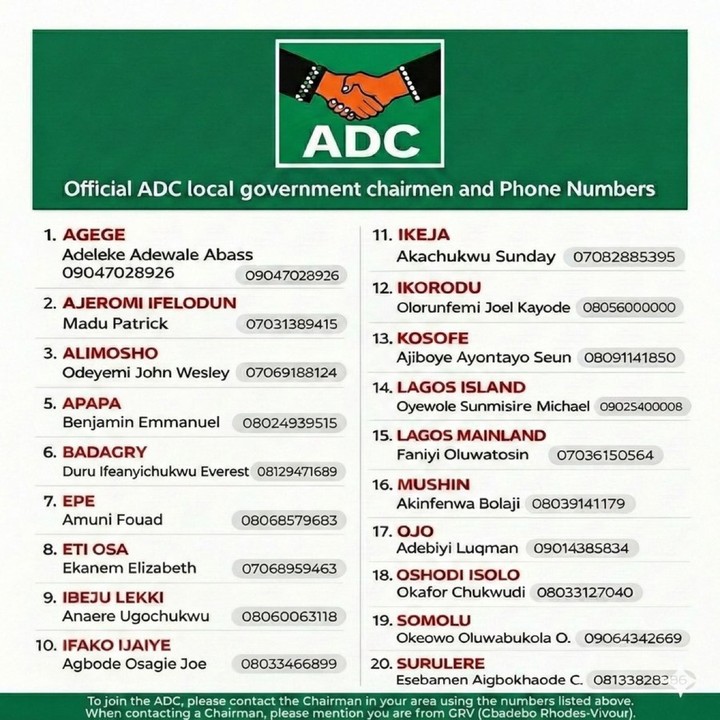

Gbadebo Chinedu Rhodes-Vivour (GRV), the Labour Party’s candidate in the 2023 Lagos State governorship election, has released a list of individuals appointed as chairmen to coordinate activities of the African Democratic Congress (ADC) across local government areas in Lagos State. The list, shared via his official social media handle, was presented as a network of party coordinators meant to strengthen ADC’s grassroots presence in the state.
According to the announcement, the named chairmen are expected to serve as contact persons and organisers at the local government level, helping to mobilise supporters and build party structures ahead of future political engagements. While the list itself was brief and informational, the reaction it generated online was anything but calm.
Almost immediately, the development triggered heated discussions across political forums and social media platforms. Supporters of Rhodes-Vivour viewed the move as a strategic attempt to consolidate opposition forces in Lagos, especially following his strong showing in the 2023 governorship election. To them, releasing a list of local coordinators signals seriousness, long-term planning, and a refusal to retreat from Lagos politics despite losing the last election.
Related News

Henry Seriake Dickson Defects from PDP to Newly Formed Nigeria Democratic Congress
Senator Henry Seriake Dickson has formally defected from the Peoples Democratic Party (PDP) to the newly registered Nigeria Democratic Congress…

Hon. Sarah Ivie Adidi Receives “Her Excellence Award” During International Women’s Day Event in Abuja
Reps aspirant Sarah Ivie Adidi has been honoured with the 2026 “Her Excellence Award” during an event marking International Women’s…

Governor Peter Mbah Urges Ndigbo to Return to Strategic Politics
Peter Mbah, Governor of Enugu State, has urged the Igbo political class to return to what he described as “strategic…
However, critics were quick to question both the intent and composition of the list. A recurring theme in the reactions was the claim that many of the appointed ADC chairmen bear Igbo names, prompting accusations of ethnic dominance and allegations that the party structure in Lagos is being “Igbonised.” Some commentators argued that such a perception could hurt the ADC and any candidate associated with it in a state where ethnic identity often plays a major role in electoral outcomes.
Others went further, linking the development to broader national politics. References were made to Peter Obi, Atiku Abubakar, and Rabiu Kwankwaso, with commenters speculating about possible future alliances, defections, or power struggles within opposition politics. Some argued that ADC could become a new rallying point for opposition figures shut out of larger parties, while others dismissed it as a weak platform with little electoral relevance in Lagos.
Another angle of criticism focused on the structure itself. Some questioned the legitimacy of appointing “chairmen” at the local government level, noting that official local government elections had already been held and that elected chairmen have a four-year tenure. In response, supporters clarified that the appointments were strictly internal party positions meant for coordination and mobilisation, not elected government offices.
The discussion also revived familiar narratives from the 2023 elections, including accusations that Lagos politics often reduces opposition candidates to ethnic labels rather than policy debates. Supporters of GRV argued that tagging opposition figures as “outsiders” or focusing on their ethnic background has long been a tactic used to discredit challengers in the state.
On the other side, sceptics questioned whether Rhodes-Vivour and ADC have the electoral strength to significantly challenge the ruling party in Lagos, pointing to past election results and voter turnout figures. Some openly mocked the initiative, describing it as political theatre rather than a serious threat.
Despite the controversy, the release of the list has achieved one clear outcome: it has put Rhodes-Vivour and the ADC back into public political discourse. Whether the move translates into genuine grassroots momentum or remains largely symbolic will depend on how effectively these appointed chairmen engage voters and expand the party’s reach beyond online debates.
As Lagos politics gradually shifts toward the next election cycle, actions like this suggest that opposition figures are already positioning themselves, testing alliances, and gauging public reaction. For now, the list of ADC chairmen has become less about names on paper and more about what it represents in Nigeria’s increasingly polarised political landscape.