Keyamo Says Kwankwaso Unlikely to Secure Presidential Ticket Ahead of 2027 Elections
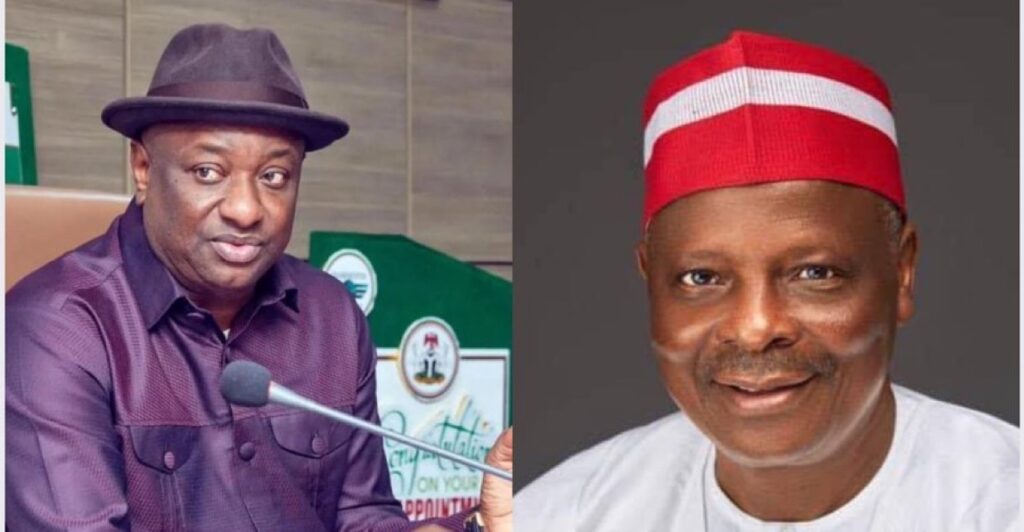

Nigeria’s Minister of Aviation and Aerospace Development, Festus Keyamo, has stirred political debate after publicly asserting that former Kano State governor and New Nigeria Peoples Party (NNPP) leader, Rabiu Musa Kwankwaso, is unlikely to emerge as a presidential candidate in the 2027 general elections. Keyamo’s remarks, which he framed as a political analysis rather than a personal attack, outline what he described as the narrowing pathways available to Kwankwaso within Nigeria’s current party landscape.
In a lengthy commentary, Keyamo acknowledged his long-standing admiration for Kwankwaso but argued that the former governor’s political choices have placed him in what he termed a “tight corner.” According to the minister, Kwankwaso’s reluctance or failure to align earlier with the ruling All Progressives Congress (APC) has significantly weakened his prospects of securing a presidential ticket from any major political party ahead of 2027.
Keyamo contended that Nigeria’s two dominant parties, the APC and the Peoples Democratic Party (PDP), are expected to zone their presidential tickets to the South in 2027, effectively shutting out Kwankwaso, who hails from the North. He further claimed that within the African Democratic Congress (ADC), former Vice President Atiku Abubakar holds overwhelming influence, making the party’s presidential ticket “Atiku’s to lose.” In his view, only a major political party has the structure and reach required to win a presidential election in Nigeria.
Related News

Henry Seriake Dickson Defects from PDP to Newly Formed Nigeria Democratic Congress
Senator Henry Seriake Dickson has formally defected from the Peoples Democratic Party (PDP) to the newly registered Nigeria Democratic Congress…

Hon. Sarah Ivie Adidi Receives “Her Excellence Award” During International Women’s Day Event in Abuja
Reps aspirant Sarah Ivie Adidi has been honoured with the 2026 “Her Excellence Award” during an event marking International Women’s…
Governor Peter Mbah Urges Ndigbo to Return to Strategic Politics
Peter Mbah, Governor of Enugu State, has urged the Igbo political class to return to what he described as “strategic…
Turning to the NNPP, Keyamo described the party as a “one-state platform,” heavily dependent on Kano State. He noted that recent defections from the NNPP, including key political figures, have raised doubts about the party’s ability to retain control of Kano in 2027. According to him, a political leader’s strength is closely tied to the loyalty and stability of their political base.
Keyamo also argued that Kwankwaso would be unwilling to support another northern presidential candidate in 2027, as doing so could effectively end his own ambition. He suggested that backing a northern candidate could push Kwankwaso into a long wait for another opportunity, given Nigeria’s informal power rotation between North and South. Based on this calculation, Keyamo dismissed the possibility of a political alliance between Kwankwaso and Atiku Abubakar in the 2027 race.
Looking beyond 2027, the minister suggested that 2031 may represent Kwankwaso’s most realistic opportunity to contest for the presidency. However, he warned that decisions taken in 2027—particularly regarding party alliances and control of Kano—would be crucial in determining Kwankwaso’s political relevance by that time. Losing grip on Kano, Keyamo argued, could significantly reduce his bargaining power within any major party in the future.
Keyamo identified three possible political platforms Kwankwaso could consider: the PDP, the APC, or the Labour Party. Each, he said, comes with significant limitations. A return to the PDP might involve rebuilding the party’s structure in Kano but would likely require Kwankwaso to suspend his presidential ambition until 2031 due to zoning. Joining the APC, according to Keyamo, would also mean accepting reduced influence, as the ruling party has strengthened its position in Kano following defections from the NNPP. As for the Labour Party, Keyamo suggested that Kwankwaso would be unlikely to accept a vice-presidential role, especially if it meant extending southern dominance for another electoral cycle.
The comments have triggered mixed reactions from political observers and supporters across party lines. While some agree with Keyamo’s assessment of Nigeria’s political arithmetic, others have accused him of being overly preoccupied with opposition politics rather than focusing on his ministerial responsibilities.
As Nigeria edges closer to another election cycle, debates over zoning, party dominance, and political alliances continue to intensify. Whether Keyamo’s analysis proves accurate remains to be seen, but it has once again highlighted the complex calculations facing major political actors as they position themselves for 2027 and beyond.