PDP Crisis Deepens as Turaki-Led NWC Accuses INEC of Bias Over Meeting With Wike Faction
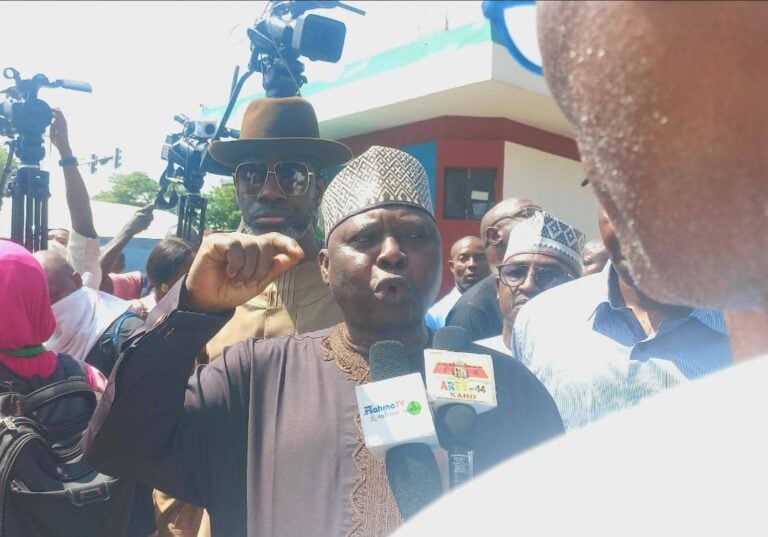

The internal crisis rocking Nigeria’s main opposition party, the Peoples Democratic Party (PDP), has intensified following fresh accusations of bias against the Independent National Electoral Commission (INEC) by the faction led by Kabiru Turaki.
The Turaki-led National Working Committee (NWC) has criticised INEC for holding a meeting with a rival PDP faction aligned with Nyesom Wike, the Minister of the Federal Capital Territory (FCT). The electoral commission recently convened a meeting with leaders of registered political parties, which was attended by Abdulrahman Mohammed, chairman of a caretaker committee established by the Wike-backed faction.
In a statement issued by Ini Ememobong, spokesperson of the Turaki-led group, Mohammed’s participation at the meeting was described as “vexatious” and a violation of INEC’s responsibility to remain neutral in political disputes. The faction argued that the electoral body should have exercised caution given the ongoing legal battles over the party’s leadership.
According to the statement, there are pending cases before the Court of Appeal seeking official recognition of Turaki as the authentic national chairman of the party. The faction insisted that INEC’s engagement with the rival group could worsen tensions within the party and potentially lead to unrest among members.
“This action, though ordinarily vexatious and capable of causing widespread breach of peace, will be met with all possible legal response,” the statement read. Ememobong added that INEC lacks the constitutional authority to impose leadership on any political party and called on members of the PDP to remain calm as the legal process unfolds.
Related News
Henry Seriake Dickson Defects from PDP to Newly Formed Nigeria Democratic Congress
Senator Henry Seriake Dickson has formally defected from the Peoples Democratic Party (PDP) to the newly registered Nigeria Democratic Congress…

Hon. Sarah Ivie Adidi Receives “Her Excellence Award” During International Women’s Day Event in Abuja
Reps aspirant Sarah Ivie Adidi has been honoured with the 2026 “Her Excellence Award” during an event marking International Women’s…
Governor Peter Mbah Urges Ndigbo to Return to Strategic Politics
Peter Mbah, Governor of Enugu State, has urged the Igbo political class to return to what he described as “strategic…
The PDP has been divided into two major factions for months, with both sides laying claim to the party’s national leadership. The crisis deepened last month when a Federal High Court in Ibadan nullified the PDP national convention held in Oyo State on November 15, 2025. The convention, backed by several prominent party figures including Oyo State Governor Seyi Makinde and Bauchi State Governor Bala Mohammed, had produced a leadership structure aligned with the Turaki faction.
In his ruling, Justice Uche Agomoh dismissed the Turaki-led group’s request for an order compelling INEC to recognise the outcomes of the convention. The judge held that the convention was conducted in violation of existing court orders and therefore could not be validated. He further barred the Turaki-led NWC from presenting itself as the party’s legitimate leadership and ruled that the PDP should operate through a caretaker committee pending the conduct of a lawful convention.
The court emphasised that political parties cannot disregard judicial orders and subsequently seek judicial endorsement for actions taken in defiance of those orders. The judgement effectively strengthened the position of the caretaker committee aligned with Wike and his allies.
Turaki, a Senior Advocate of Nigeria (SAN), rejected the ruling and described it as flawed, arguing that the court granted reliefs that were not requested by any of the parties involved. He confirmed that the faction has filed an appeal and a motion for stay of execution, maintaining that the convention remains legally valid.
Prior to the disputed convention, the PDP had been grappling with conflicting court rulings from different jurisdictions. While some federal high courts in Abuja ordered a halt to the convention over alleged breaches of party and electoral laws, a high court in Oyo State allowed the exercise to proceed and directed INEC to monitor it.
The crisis also led to the expulsion of Wike and his allies from the party during the convention. In response, the Wike group established a parallel NWC, board of trustees, and national executive committee, further entrenching divisions within the party.
In December, INEC declined to recognise the Turaki-led NWC, citing multiple court judgements and legal uncertainties surrounding the party’s leadership. The commission has maintained that it will continue to operate in line with subsisting court orders.
As legal battles continue, the PDP’s internal divisions have raised concerns about the party’s ability to function effectively as a cohesive opposition force ahead of future elections. Political observers note that prolonged leadership disputes and factional infighting could weaken the party’s organisational structure and electoral prospects if not resolved through legal or political reconciliation.
The coming months are expected to be critical as court decisions and possible negotiations among party stakeholders determine the future leadership and direction of one of Nigeria’s major political parties.