El-Rufai Says He Would Have Joined Peter Obi’s ‘Occupy NASS’ Protest Over Electronic Transmission of Results
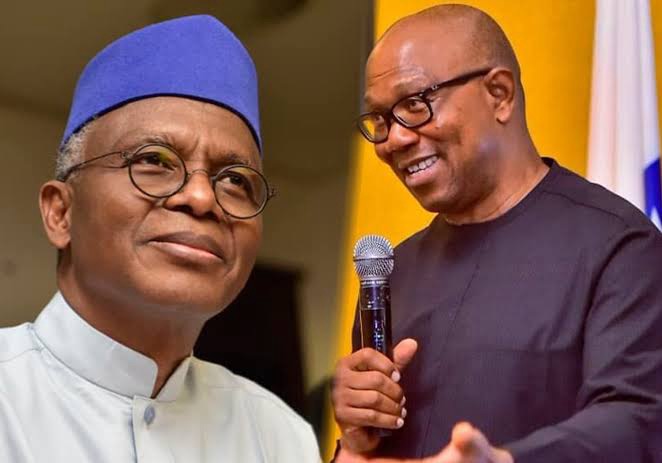

Former Kaduna State governor and prominent political figure Nasir El-Rufai has expressed support for the “Occupy NASS” protest held at the National Assembly complex in Abuja, stating that he would have personally joined former presidential candidate Peter Obi in the demonstration if he had been in the country.
The protest, which took place earlier in the week, drew a sizable turnout of political supporters, civil society groups, and concerned citizens. Demonstrators gathered at the National Assembly to demand the inclusion of real-time electronic transmission of election results in the amended Electoral Act. The protesters argued that the adoption of electronic transmission would enhance transparency, reduce electoral fraud, and strengthen public confidence in Nigeria’s electoral system ahead of the 2027 general elections.
Peter Obi, who led the protest, has consistently advocated for reforms in the electoral process, particularly the use of technology to ensure accurate and timely reporting of election results. Supporters of the reform maintain that real-time electronic transmission could help curb manipulation and improve the credibility of elections in Africa’s most populous nation.
Related News

Henry Seriake Dickson Defects from PDP to Newly Formed Nigeria Democratic Congress
Senator Henry Seriake Dickson has formally defected from the Peoples Democratic Party (PDP) to the newly registered Nigeria Democratic Congress…

Hon. Sarah Ivie Adidi Receives “Her Excellence Award” During International Women’s Day Event in Abuja
Reps aspirant Sarah Ivie Adidi has been honoured with the 2026 “Her Excellence Award” during an event marking International Women’s…
Governor Peter Mbah Urges Ndigbo to Return to Strategic Politics
Peter Mbah, Governor of Enugu State, has urged the Igbo political class to return to what he described as “strategic…
Speaking during a media interview on Monday, El-Rufai aligned himself with the demands of the protesters. He emphasized that electronic transmission of results is a necessary step toward ensuring credible elections and preventing potential irregularities in future polls. According to him, the House of Representatives had already passed provisions supporting electronic transmission, but the Senate’s refusal to assent to the measure has raised concerns among stakeholders.
“I would have joined Peter Obi to protest at the National Assembly if I were in the country,” El-Rufai said. “Real-time electronic transmission stops rigging. It was passed by the House of Representatives, but the Senate is frustrating it because the ruling party knows it cannot win without manipulating the electoral process.”
El-Rufai further alleged that the ruling All Progressives Congress (APC) may face significant challenges in securing victory in the 2027 general elections without reforms that guarantee transparency. He suggested that resistance to electronic transmission of results could be politically motivated, though he did not provide detailed evidence to support the claim.
The protest and El-Rufai’s remarks have sparked widespread reactions across political circles and among the public. Supporters of the proposed electoral reform argue that technological improvements in vote transmission are long overdue and essential for safeguarding democratic processes. Many believe that implementing real-time electronic transmission could address longstanding concerns about result manipulation and delays in collation.
However, critics of the protest and of opposition figures involved have dismissed the claims, arguing that Nigeria’s electoral challenges extend beyond result transmission technology. Some have also questioned the credibility and motivations of opposition leaders pushing for reforms, suggesting that broader structural and institutional issues must be addressed to improve electoral integrity.
Political analysts note that debates over electoral reforms are likely to intensify as the 2027 elections approach. The issue of electronic transmission of results has become a central point of contention between various political actors, reflecting broader concerns about trust in Nigeria’s electoral institutions.
As discussions continue, stakeholders across party lines and civil society are expected to engage with lawmakers and the Independent National Electoral Commission (INEC) on possible reforms. Whether the National Assembly will revisit the electronic transmission provision remains uncertain, but the growing public discourse suggests that electoral transparency will remain a dominant theme in Nigeria’s political landscape in the coming years.