Atiku Accuses APC of Undermining Democracy After Meeting with IBB in Minna
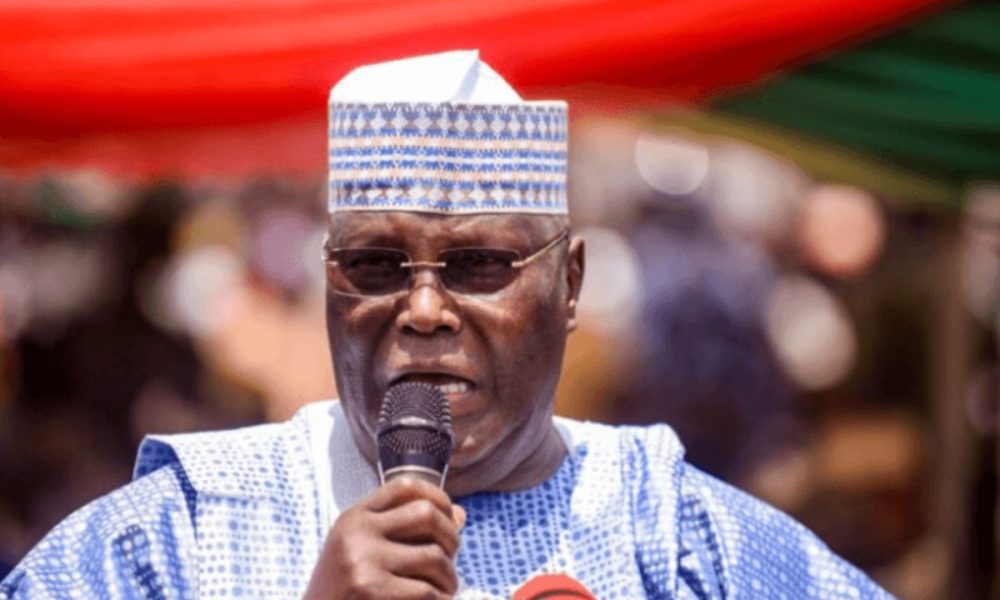

Former Vice President Atiku Abubakar has launched a fresh round of criticism against Nigeria’s ruling All Progressives Congress (APC), accusing the party of undermining democratic principles and manipulating electoral processes. He made the remarks after a closed-door meeting with former Military President, General Ibrahim Badamasi Babangida (retd.), in Minna, Niger State.
The meeting, which took place at Babangida’s residence, lasted for nearly two hours. Journalists and supporters reportedly waited outside the premises while discussions were ongoing, although details of the private conversation were not publicly disclosed.
Speaking with reporters after the meeting, Atiku criticised the APC’s approach to governance and electoral reforms, describing the party as deeply flawed. He alleged that the ruling party had a pattern of undermining democratic institutions and processes.
“What do you expect? APC generally is a party of forgers and riggers,” Atiku said. “They forge everything, certificates, age limits — they forge everything. That is the hallmark of APC.”
The former vice president also expressed dissatisfaction with recent developments in the National Assembly concerning electoral reform proposals. He particularly faulted the Senate’s position on the transmission of election results, which has remained a contentious issue in Nigeria’s electoral framework.
Related News
Henry Seriake Dickson Defects from PDP to Newly Formed Nigeria Democratic Congress
Senator Henry Seriake Dickson has formally defected from the Peoples Democratic Party (PDP) to the newly registered Nigeria Democratic Congress…

Hon. Sarah Ivie Adidi Receives “Her Excellence Award” During International Women’s Day Event in Abuja
Reps aspirant Sarah Ivie Adidi has been honoured with the 2026 “Her Excellence Award” during an event marking International Women’s…
Governor Peter Mbah Urges Ndigbo to Return to Strategic Politics
Peter Mbah, Governor of Enugu State, has urged the Igbo political class to return to what he described as “strategic…
Atiku noted that many Nigerians had hoped for a fully electronic, real-time transmission of election results from polling units across the country. According to him, the current proposal — which allows a combination of electronic and manual transmission — falls short of public expectations and could create further complications.
“First and foremost, it is below the expectation of Nigerians, because Nigerians were expecting real-time transmission of election results at the various levels,” he said. “What we got instead is a mixture of electronic and manual transmission, which is going to cause more confusion and chaos than if we had a single-tier electronic transmission of results.”
He urged opposition parties and stakeholders across the political spectrum to unite in demanding credible electoral reforms. Atiku stressed that the matter should not be allowed to fade without sustained pressure from political actors and civil society.
“We must come together to pursue this issue. We shouldn’t allow it to rest where they want it to rest. Absolutely not. I don’t support that,” he added.
When asked about the possibility of contesting the 2027 presidential election, Atiku dismissed the notion, stating that it is not currently under consideration. He explained that his immediate focus is on strengthening the African Democratic Congress (ADC), the political platform with which he is now affiliated.
“The question of contesting the 2027 election does not even arise,” he said. “I am a member of ADC and we are busy ensuring our structures are firmly rooted at ward, local, state, and national levels.”
Atiku further revealed that the ADC is concentrating on nationwide mobilisation and membership registration as part of efforts to build a strong political structure ahead of future elections. He also noted that the party does not enshrine zoning in its constitution, contrasting it with the Peoples Democratic Party (PDP), where zoning arrangements are formally recognised.
Meanwhile, Oyo State Governor Seyi Makinde also held a separate private meeting with Babangida at the same residence. However, the governor declined to speak with journalists after his visit, leaving the purpose of his meeting undisclosed.
The developments reflect ongoing political realignments and strategic consultations among key figures in Nigeria’s political landscape as discussions around electoral reforms and future elections continue to shape national discourse.