US Ambassador Huckabee Faces Backlash Over Remarks on Possible Israeli Expansion
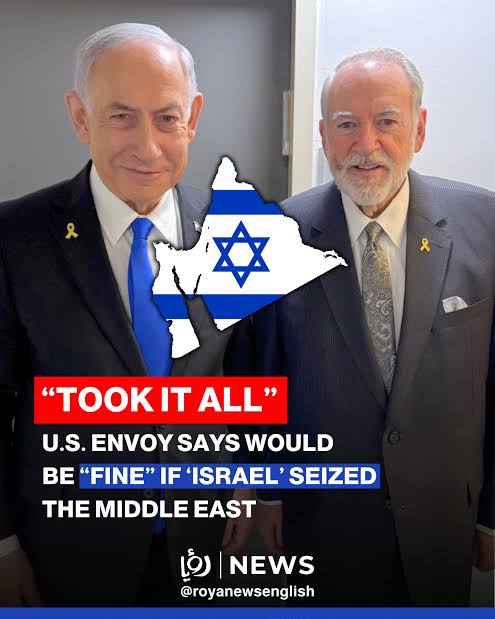

The United States ambassador to Israel, Mike Huckabee, has stirred controversy following remarks suggesting that he would not object if Israel were to expand its territory across much of the Middle East.
Speaking in an interview with conservative political commentator Tucker Carlson, Huckabee was asked about the geographical scope of Israel’s borders and whether biblical interpretations should influence modern territorial claims. During the discussion, Carlson referenced biblical descriptions of land promised to the descendants of Abraham, spanning from the Euphrates River to the Nile River — a region that would encompass parts of present-day Lebanon, Syria, Jordan, Iraq, Egypt, and Saudi Arabia.
“It would be fine if they took it all,” Huckabee responded when asked about the possibility of Israel controlling such territory. The ambassador, who was appointed by US President Donald Trump last year, later clarified that his statement was “somewhat of a hyperbolic statement,” indicating that it was not meant as a formal policy position.
Pressed further during the interview, Huckabee suggested that territorial changes could arise as a consequence of conflict. “If they end up getting attacked by all these places, and they win that war, and they take that land, OK, that’s a whole other discussion,” he said.
Related News

Six US Troops Killed in Iranian Strike on Kuwait Port, Says CENTCOM
The United States Central Command has confirmed that six American service members were killed following an Iranian strike on a…

Trump-Linked Financier Signs Preliminary Gas Deal With Russia’s Novatek for Alaska Project
An American financier with ties to former U.S. President Donald Trump has reportedly signed an early-stage agreement with Russian energy…
US Commends NAF Ahead of AH-1Z Helicopter Delivery
The United States Government has praised the Nigerian Air Force for its preparedness ahead of the delivery of AH-1Z attack…
The comments have fueled debate about US diplomatic posture in the Middle East, particularly given longstanding international norms governing sovereignty and territorial integrity. Since the end of World War II, the prohibition against acquiring territory by force has been a cornerstone of international law.
In 2024, the International Court of Justice (ICJ) ruled that Israel’s occupation of Palestinian territories is illegal and must cease, reinforcing international scrutiny over territorial disputes in the region. Meanwhile, the International Criminal Court (ICC) has also faced criticism from Israeli and US officials over its investigations and legal actions related to the conflict.
Huckabee, a longtime Christian Zionist, used the interview to criticize international legal institutions, arguing that bodies such as the ICC and ICJ have become politicized. He expressed support for efforts by the Trump administration and Secretary of State Marco Rubio to challenge what he described as bias within those organizations.
Israel’s borders remain a complex and contested issue. While the country does not have formally codified final borders in domestic law, it maintains control over territories captured during past conflicts. Israel annexed the Golan Heights in 1981, a move widely considered illegal under international law but recognized by the United States. Following the 2024 conflict with Hezbollah, Israeli forces also established military positions in parts of southern Lebanon.
The concept of a “Greater Israel” has periodically surfaced in Israeli political discourse. Prime Minister Benjamin Netanyahu has at times referenced historical and security considerations regarding territorial boundaries. In 2023, Finance Minister Bezalel Smotrich faced international backlash after speaking at an event where a map depicted Israel encompassing Palestinian territories and portions of neighboring countries.
Beyond the territorial debate, Huckabee has also faced criticism over meetings conducted during his ambassadorship. He confirmed meeting with Jonathan Pollard, a former US Navy civilian analyst convicted of espionage for passing classified information to Israel during the Cold War. Pollard served 30 years in prison before relocating to Israel in 2020. Huckabee defended the meeting, stating that it was scheduled through proper channels and that he meets with a wide range of individuals in his diplomatic capacity.
The US Department of State has not issued a formal clarification on whether Huckabee’s comments reflect official policy. Analysts note that while ambassadors may express personal views, official US policy on territorial disputes traditionally emphasizes negotiated settlements and adherence to international law.
The remarks have prompted varied reactions across political and diplomatic circles, underscoring the sensitivity of territorial issues in a region already marked by decades of conflict. As debates continue, observers say the episode highlights the ongoing tension between religious interpretations, national security considerations, and the principles that underpin the modern international system.