PDP Launches Nationwide Digital Membership Registration Ahead of Electoral Act Compliance Deadline
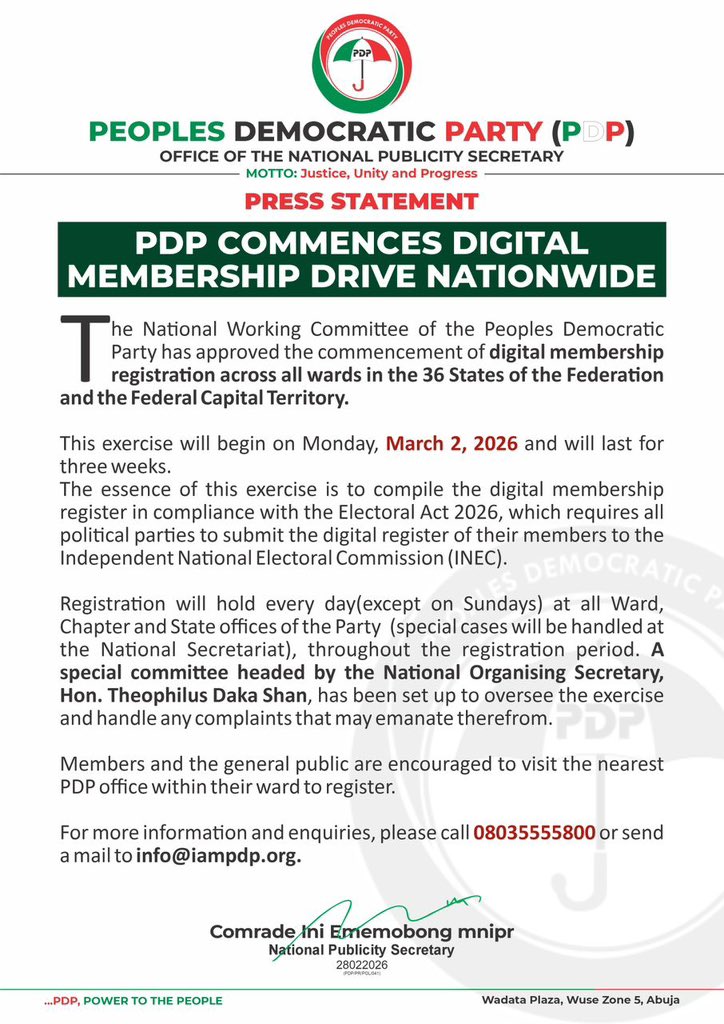

The Peoples Democratic Party (PDP) has officially commenced a nationwide digital membership registration exercise, marking a significant step in its efforts to align with the requirements of the Electoral Act 2026.
The decision was approved by the party’s National Working Committee and announced in a statement signed by the National Publicity Secretary, Comrade Ini Ememobong. According to the statement, the registration drive will take place across all wards in Nigeria’s 36 states and the Federal Capital Territory (FCT).
The exercise is scheduled to begin on Monday, March 2, 2026, and will run for three weeks. During this period, registration will be conducted daily—except on Sundays—at ward, chapter, and state offices of the party nationwide. Special cases will be handled at the party’s National Secretariat.
The PDP said the primary objective of the digital registration exercise is to compile a comprehensive electronic membership register in compliance with the Electoral Act 2026. The law requires all registered political parties to submit a digital register of their members to the Independent National Electoral Commission (INEC).
To oversee the process, the party has constituted a special committee headed by its National Organising Secretary, Hon. Theophilus Daka Shan. The committee is tasked with supervising the registration process, ensuring transparency, and addressing complaints or disputes that may arise during the exercise.
Related News

Henry Seriake Dickson Defects from PDP to Newly Formed Nigeria Democratic Congress
Senator Henry Seriake Dickson has formally defected from the Peoples Democratic Party (PDP) to the newly registered Nigeria Democratic Congress…

Hon. Sarah Ivie Adidi Receives “Her Excellence Award” During International Women’s Day Event in Abuja
Reps aspirant Sarah Ivie Adidi has been honoured with the 2026 “Her Excellence Award” during an event marking International Women’s…

Governor Peter Mbah Urges Ndigbo to Return to Strategic Politics
Peter Mbah, Governor of Enugu State, has urged the Igbo political class to return to what he described as “strategic…
Party members and interested Nigerians have been encouraged to visit the nearest PDP office within their ward to register. The leadership also provided official contact channels—including a dedicated phone number and email address—for inquiries and support.
The announcement has generated reactions across the political spectrum. Supporters of the party described the move as proactive and indicative of a structured political organisation preparing early for future electoral processes. Some commentators noted that digital documentation enhances internal accountability and strengthens party data management.
However, critics have raised broader questions about the timing and political implications of digital compliance measures. Discussions in political circles have linked the new digital requirements to ongoing debates about electronic transmission of election results and the broader digitalisation of Nigeria’s electoral system.
While the PDP’s leadership framed the exercise strictly as compliance with statutory obligations, observers say it also reflects intensifying preparations ahead of future elections. Maintaining an accurate and verifiable membership database is widely seen as critical for party primaries, delegate accreditation, and internal democratic processes.
Political analysts point out that digital membership systems could improve transparency within party structures, reduce duplication of records, and limit disputes over authentic membership lists. In past election cycles, disagreements over party registers have contributed to internal crises and litigation.
The PDP’s move may also put pressure on other political parties to accelerate similar processes to meet regulatory deadlines. As INEC continues to strengthen documentation standards, digital compliance is becoming a non-negotiable requirement for political organisations seeking to remain competitive and legally compliant.
With the three-week window now open, party officials say they expect widespread participation across the federation. The success of the exercise will likely depend on effective coordination at the grassroots level, adequate public awareness, and efficient handling of logistical challenges.
As Nigeria’s political landscape continues to evolve under new legal and technological frameworks, the PDP’s digital membership drive signals a growing shift toward data-driven political organisation in the country.