Lagos Government Asked Landlord to Pay ₦400,000 to Unseal Her House Despite Having Complete Documents

Life in Lagos, Nigeria’s commercial capital, often comes with unexpected challenges for residents, landlords, and tenants alike. From traffic congestion to high living costs and complex bureaucratic systems, many people living in the city frequently encounter situations that test their patience. A recent incident shared online by a landlord highlights the difficulties some property owners face when dealing with government regulatory agencies, even when they have complied with official requirements.
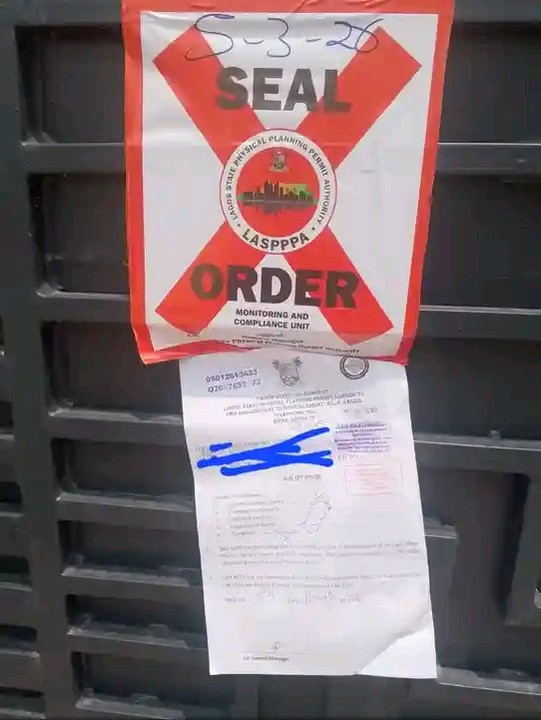
The landlord narrated how she returned home one evening only to discover that her house had been sealed by government officials. A chain had been placed across the main gate, preventing vehicles from entering the compound. Only the smaller pedestrian gate remained open. The unexpected action came as a shock because she had no prior warning or explanation about what rule had been violated.
According to her account, the seal was placed by officials connected to the Lagos State Physical Planning Permit Authority (LASPPA), an agency responsible for aspects of planning permits and regulatory enforcement in Lagos. Another related agency involved in monitoring building construction in the state is the Lagos State Building Control Agency (LASBCA). These agencies are tasked with ensuring that buildings comply with approved plans and safety regulations.
Confused by the situation, the landlord decided to visit the agency’s office the following day. She made photocopies of all her property documents, including the building permit, to prove that the house had been legally approved. When she met the officials and asked why her property had been sealed, they initially asked whether she had a building permit.
She responded by pointing out that the government already collects significant fees for issuing permits and should therefore have the records on file. Nevertheless, she presented the documents to them. After reviewing the paperwork, the officials reportedly admitted that everything was complete and in order. Despite acknowledging that the building permit was valid, they still told her that she would need to pay ₦400,000 to have the property unsealed.
The demand left the landlord confused and frustrated. She asked why the building had been sealed in the first place if all the documents were correct. According to the officials, a letter might have been sent earlier notifying her of an issue, and they suggested she might not have responded to it. The landlord insisted that no such letter had ever reached her. She explained that the only previous correspondence she received from the agency was the previous year when she submitted her documents for verification.
Related News

Lagos Ready for State Police, Says LNSA Chief Ifalade
Lagos State has declared its readiness for the establishment of state police in Nigeria, with the leadership of the Lagos…

Lagos State Holds Nigeria’s Largest Subnational Domestic Debt at ₦1.05 Trillion, Data Shows
New data from Nigeria’s Debt Management Office indicates that Lagos State holds the largest domestic debt among all states, standing…

Lagos to Expand Red Line Capacity With Three New Eight-Coach Trains by Q3 2026
The Lagos State Government has announced plans to add three new eight-coach trains to the Red Line rail system by…
The conversation reportedly continued with back-and-forth arguments. At some point, the officials allegedly suggested that she could pay a smaller amount simply to collect the key and have the seal removed. The negotiation reportedly resembled bargaining in a marketplace rather than a formal government process.
The situation became even more suspicious when the officials allegedly provided a personal bank account into which the payment should be made. The account belonged to an individual and was held at Access Bank. The landlord immediately rejected this arrangement, stating that she would only make payments into an official government account linked to the appropriate agency.
Her insistence reportedly caused tension in the office, with some officials expressing frustration that she refused to follow their suggestion. Despite the pressure, she maintained that any payment must go through the official state payment channel.
Eventually, after further discussions and delays, she was directed to a bank located within the same building where she could make a legitimate payment through the proper government account. Only after completing the official payment process was the issue resolved.
Although the situation eventually ended without further complications, the experience left the landlord exhausted and disappointed. She reflected that she had often seen similar seal notices on other buildings but never realized that some of those property owners might actually have complete and valid documentation.
The story sparked discussion online about the challenges of dealing with bureaucracy and the possibility of unofficial payments within regulatory systems. Many residents of Lagos say such experiences are not uncommon when interacting with agencies responsible for building approvals and compliance.
However, regulatory oversight remains important in a rapidly expanding city like Lagos. With continuous population growth and intense property development, government agencies must ensure that buildings meet safety and planning standards. Proper enforcement helps prevent dangerous structures, illegal developments, and urban planning problems.
At the same time, transparency and accountability are essential for maintaining public trust. When enforcement actions appear inconsistent or when citizens are asked to make payments through unofficial channels, it creates suspicion and damages confidence in government institutions.
The incident ultimately highlights the importance of awareness and persistence when dealing with bureaucratic systems. By refusing to pay money into a personal account and insisting on using an official payment channel, the landlord ensured that the transaction remained legitimate.
In a city as vibrant and complex as Lagos, the relationship between citizens and regulatory authorities continues to evolve. While enforcement of building regulations is necessary, fairness, transparency, and clear communication are equally important to ensure that residents who follow the rules are treated justly.