11 Nigerian Soldiers Detained After Military Aircraft Forced to Land in Burkina Faso Over Airspace Violation
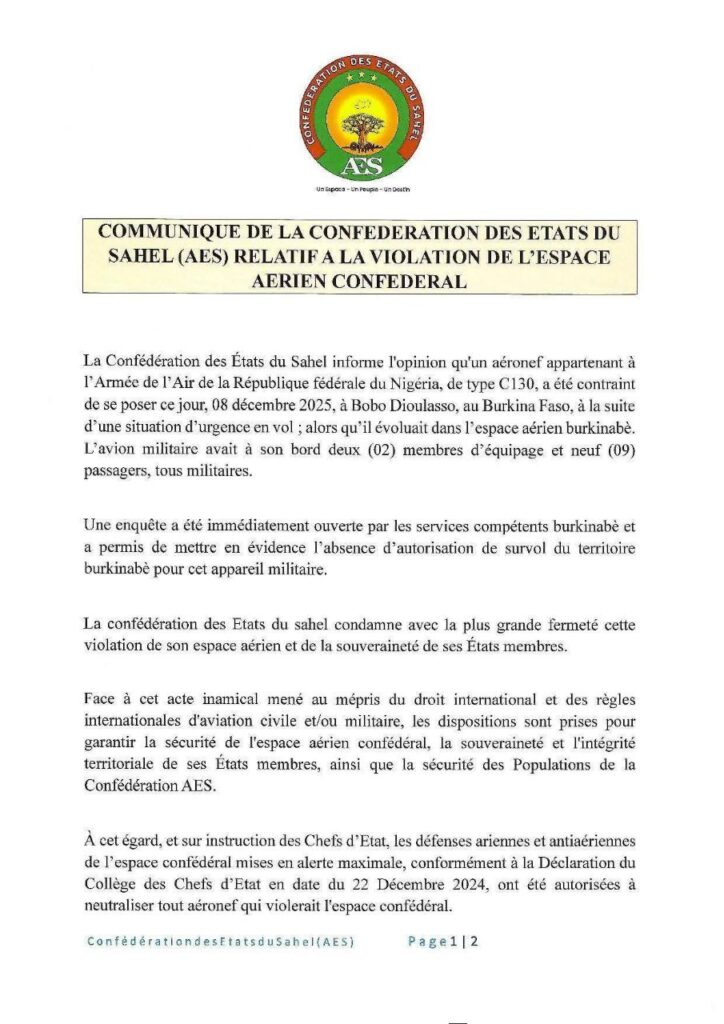

Tensions have risen in West Africa following the detention of 11 Nigerian soldiers in Burkina Faso after a Nigerian military aircraft allegedly violated the country’s airspace without formal clearance. The development was confirmed in an official communiqué issued on December 8, 2025, by the Confederation of Sahel States (AES), a security bloc formed by Mali, Burkina Faso, and Niger.
According to the statement, a Nigerian Air Force C-130 aircraft was forced to land in the city of Bobo-Dioulasso after experiencing what was described as an in-flight emergency. On board the aircraft were two crew members and nine passengers, all identified as Nigerian military personnel. Upon landing, Burkinabe authorities immediately opened an investigation, which reportedly revealed that the aircraft did not have authorisation to operate within Burkinabe airspace.
The AES described the incident as a violation of its confederal airspace and an affront to the sovereignty of its member states. In strongly worded language, the regional bloc condemned what it termed a hostile act carried out in disregard of international aviation and military regulations. As a response, the AES announced the activation of maximum air and anti-air defence alert across its territories.
The communiqué, signed in Bamako by Army General Assimi Goïta—President of Mali and current President of the Confederation of Sahel States—declared that, under instructions from the Heads of State of the alliance, any aircraft violating AES airspace could henceforth be neutralised. The statement referenced a prior declaration made on December 22, 2024, which authorised aggressive air defence measures to safeguard territorial integrity and civilian populations across member states.
Related News
Nigeria Moves to Modernise Air Defence Systems Amid Growing Security Concerns
Nigeria is reviewing proposals from Chinese and European defence companies to modernise its ageing air defence infrastructure as part of…

Rights Group Accuses Police of Judicial Persecution Over Remand of Blogger Maureen Badejo
The Committee for the Defence of Human Rights (CDHR) has accused the Nigeria Police Force of engaging in judicial persecution…
Tinubu Approves Salary Increase for Nigerian Armed Forces Personnel
President Bola Ahmed Tinubu has approved a salary increase and improved allowances for members of the Nigerian Armed Forces as…
While Nigerian authorities had not, at the time of reporting, issued a formal public response to the detention, the incident has sparked widespread reactions across Nigeria, particularly on social media platforms. Many citizens expressed concern over the safety of the detained soldiers, while others called for swift diplomatic engagement to prevent escalation.
Some commentators questioned the nature of the mission the Nigerian aircraft was undertaking, raising issues about whether the operation fell under ECOWAS security cooperation frameworks or an independent military assignment. Others warned that the diplomatic environment between Nigeria, ECOWAS, and the Sahel military governments remains highly strained following recent coups in Mali, Burkina Faso, and Niger, as well as disagreements over sanctions and regional security arrangements.
Security analysts have noted that Burkina Faso, Mali, and Niger formally withdrew from ECOWAS earlier in 2025 and subsequently strengthened their military alliance under the AES framework. This realignment has significantly altered the security balance in the Sahel, with growing military cooperation between the AES bloc and external partners such as Russia. Observers believe this shift has emboldened the AES leadership to take a tougher stance against perceived airspace violations and foreign military movements.
Public reactions in Nigeria have ranged from calls for restraint and diplomacy to more hardline positions demanding the immediate release of the detained personnel. Some voices warned that any military confrontation in the Sahel could quickly draw in multiple regional actors and destabilise an already fragile security landscape across West Africa.
There are also fears about the broader implications of the AES declaration authorising the neutralisation of foreign aircraft. Aviation and security experts caution that miscalculations in such a tense environment could result in unintended military confrontations, particularly in a region already burdened by insurgency, terrorism, and cross-border criminal activity.
As diplomatic channels are expected to be activated quietly behind the scenes, the fate of the 11 detained Nigerian soldiers remains uncertain. The incident underscores the growing complexity of military coordination in West Africa following the fragmentation of traditional regional security alliances and highlights the delicate balance between sovereignty, counterterrorism operations, and international aviation law.
For now, attention remains focused on whether Nigeria and the AES leadership can resolve the matter through dialogue, or whether the development could further deepen diplomatic and security rifts across the Sahel and the wider West African region.