2027 Power Struggle: Rivers Political Crisis Deepens as APC Governors Rally Behind Fubara
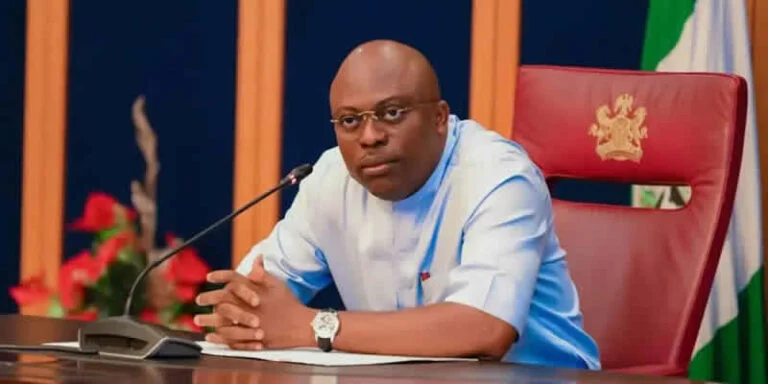

The simmering political crisis in Rivers State has taken a sharper and more consequential turn as the battle for 2027 gathers momentum, with fresh indications that Governor Siminalayi Fubara is enjoying growing backing from powerful figures within the All Progressives Congress (APC). This emerging support appears to have significantly weakened the influence of the Minister of the Federal Capital Territory, Nyesom Wike, who has remained openly opposed to Fubara’s second-term ambition.
Multiple sources within the APC disclosed that the renewed hostility between Wike and Fubara was triggered by decisions taken by some top APC governors to align themselves with the Rivers governor. According to party insiders, this development was deeply unsettling to Wike, who had expected to retain firm control over political outcomes in the state even after leaving office.
The situation was further complicated by what party sources described as a broader endorsement of Fubara by key elements of the APC leadership. Several party leaders are said to have been impressed by Fubara’s governance style and the scale of infrastructure projects executed across Rivers State, factors that reportedly boosted his standing within the party’s national hierarchy.
Tensions reportedly escalated following an unrelated political move in Imo State, where forces loyal to Wike were accused of attempting to push the former National Secretary of the Peoples Democratic Party (PDP), Samuel Anyanwu, as a governorship candidate without consulting Governor Hope Uzodimma. Uzodimma, who also chairs the APC Governors’ Forum, was said to have been angered by the development. This incident allegedly became the tipping point that prompted some APC governors to quietly mobilise against Wike.
According to a senior APC official, the strategy was clear: weaken Wike’s political base in Rivers State and curtail his growing influence within the ruling party. The official added that Wike’s strained relationships with some powerful figures in the Tinubu administration made it easier for governors to openly align with Fubara.
Related News

Henry Seriake Dickson Defects from PDP to Newly Formed Nigeria Democratic Congress
Senator Henry Seriake Dickson has formally defected from the Peoples Democratic Party (PDP) to the newly registered Nigeria Democratic Congress…

Hon. Sarah Ivie Adidi Receives “Her Excellence Award” During International Women’s Day Event in Abuja
Reps aspirant Sarah Ivie Adidi has been honoured with the 2026 “Her Excellence Award” during an event marking International Women’s…
Governor Peter Mbah Urges Ndigbo to Return to Strategic Politics
Peter Mbah, Governor of Enugu State, has urged the Igbo political class to return to what he described as “strategic…
Another party source revealed that assurances of support from APC governors had emboldened Fubara to openly challenge Wike’s dominance in the state. This confidence, observers say, explains the governor’s increasingly assertive political posture since his defection from the PDP to the APC in December.
The political drama spilled into the open as the APC National Secretary, Ajibola Basiru, and Wike exchanged sharp words over Rivers State politics. Basiru publicly declared support for Fubara and advised Wike to resign his ministerial post if he wished to fully immerse himself in state-level political battles. He also warned APC officials, particularly the party’s South-South Vice Chairman, Victor Giadom, against making statements that undermine sitting governors.
Giadom had earlier insisted that Fubara could not succeed politically without Wike’s backing, describing Gokana Local Government Area as Wike’s unchallenged political stronghold. His remarks sparked outrage within party circles and drew a swift rebuke from Basiru, who accused him of belittling the governor.
Wike, however, responded forcefully during a “thank-you” visit to Oyigbo Local Government Area, warning Basiru and other APC leaders to steer clear of Rivers State politics. He issued thinly veiled threats, insisting that Rivers was a political “no-go area” and cautioning against taking the state’s support for President Bola Tinubu for granted.
In a strongly worded response, Basiru rejected Wike’s warnings, stressing that the FCT minister had no authority to interfere in APC affairs, as he was not a registered member of the party. He reaffirmed his role as national secretary, stating that his oversight responsibilities extended to all states, including Rivers.
Basiru also dismissed claims that he was interested in Rivers State’s financial resources, describing such allegations as baseless and inconsistent with his record of public service. He insisted that intimidation would not deter him from taking principled positions within the party.
The crisis has its roots in a post-election agreement reportedly brokered by President Tinubu to resolve the initial fallout between Wike and Fubara. Central to that deal, according to widespread reports, was an understanding that Fubara would not seek re-election in 2027. However, Fubara’s subsequent defection to the APC and the backing he now appears to enjoy have cast doubt on the durability of that agreement.
Wike has continued to accuse his successor of reneging on commitments and insists that Fubara lacks the political strength to secure a second term. Yet, with influential APC governors now openly or quietly backing the Rivers governor, the balance of power appears to be shifting.
As 2027 approaches, Rivers State is shaping up to be one of Nigeria’s most fiercely contested political battlegrounds, with internal party rivalries, personal ambitions, and national power dynamics converging in a high-stakes struggle that could redefine the state’s political future.