23 Nigerian Banks Meet CBN’s New Capital Requirements Ahead of 2026 Deadline


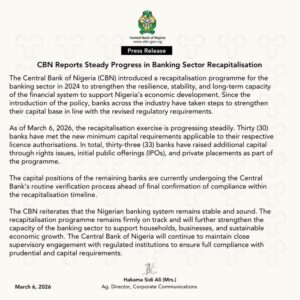
The Central Bank of Nigeria (CBN) has announced that 23 Nigerian banks have successfully met the new minimum capital requirements introduced under its ongoing recapitalization exercise.
The policy, unveiled as part of efforts to enhance financial system stability and resilience, requires banks to meet revised capital thresholds based on their operating licenses. Under the new framework, international commercial banks must maintain a minimum capital base of ₦500 billion, national commercial banks are required to hold ₦200 billion, while regional banks must meet a ₦50 billion benchmark. The compliance deadline has been set for March 31, 2026.
According to available information, the following 23 banks have already satisfied the CBN’s recapitalization requirements:
-
Access Bank Plc
-
Zenith Bank Plc
-
First Bank of Nigeria Limited (First HoldCo)
-
Guaranty Trust Holding Company (GTCO)
-
United Bank for Africa (UBA)
-
Fidelity Bank Plc
-
Wema Bank Plc
-
Citibank Nigeria
-
Standard Chartered Bank Nigeria
-
Ecobank Nigeria
-
Globus Bank
Related News
30 Nigerian Banks Meet New Capital Requirements Ahead of CBN Recapitalisation Deadline
The Central Bank of Nigeria has announced that 30 banks operating in the country successfully met the new minimum capital…

Tinubu Announces Global Acceptance of Naira Cards for International Transactions
President Bola Ahmed Tinubu has announced that Nigerian-issued Naira debit cards can now be used for transactions worldwide, describing the…

Court Orders Attachment of ₦29 Billion in Access Bank Funds, Triggering Sector-Wide Anxiety
A Federal High Court in Lagos has ordered the attachment of nearly ₦29 billion from Access Bank’s funds domiciled with…
-
Stanbic IBTC Bank
-
PremiumTrust Bank
-
Providus Bank (including its merged entity)
-
FSDH Merchant Bank
-
Greenwich Merchant Bank
-
Nova Bank
-
Rand Merchant Bank
-
Jaiz Bank
-
Lotus Bank
-
TAJBank
-
Sterling Bank
-
Alternative Bank (AltBank)
The recapitalization directive is widely viewed as one of the most significant regulatory moves in Nigeria’s banking sector in recent years. Analysts say the policy is designed to cushion the financial system against economic shocks, currency volatility, and global market uncertainties, while positioning Nigerian banks to support large-scale infrastructure financing and economic expansion.
Public reaction to the announcement has been mixed. Some depositors expressed relief that their banks are already compliant, interpreting the development as a positive indicator of financial strength. Others raised questions about institutions not listed among the 23, including banks such as Union Bank, FCMB, Polaris Bank, and Keystone Bank. Industry observers note that banks still have time before the 2026 deadline and may be pursuing capital-raising strategies, mergers, or license adjustments to meet regulatory thresholds.
The discussion has also extended to digital-first financial institutions and fintech platforms, with some customers seeking clarification about whether neobanks fall under the same capital requirements as traditional commercial banks. Regulatory classifications vary depending on licensing structure, and the CBN has not indicated any change to the compliance timeline at this stage.
Economic commentators suggest that recapitalization exercises, while potentially demanding for smaller institutions, can enhance long-term stability and investor confidence. However, they also acknowledge that consolidation within the sector remains a possibility if some banks are unable to independently meet the new benchmarks.
As the March 2026 deadline approaches, stakeholders will be watching closely to see whether additional institutions meet the requirements or whether strategic mergers and restructuring reshape Nigeria’s banking landscape once again.