30 Nigerian Banks Meet New Capital Requirements Ahead of CBN Recapitalisation Deadline
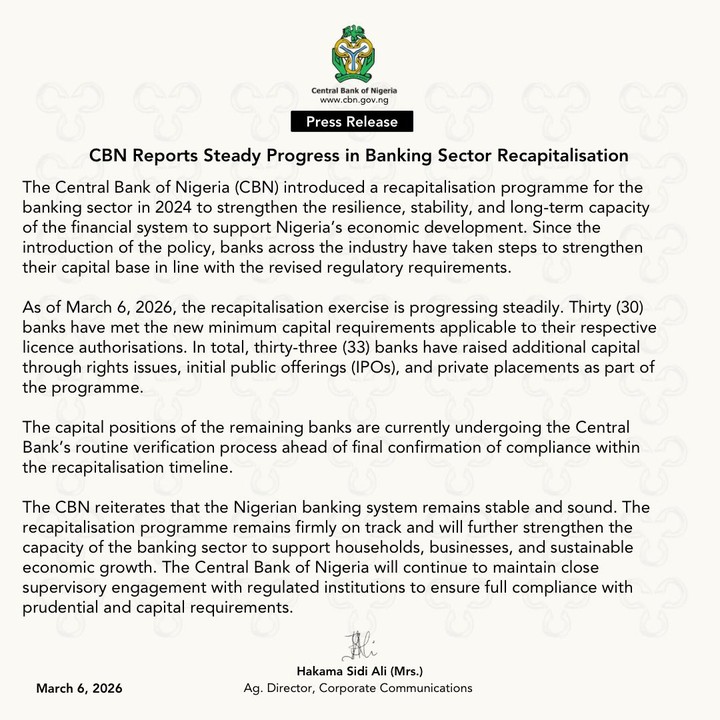

The Central Bank of Nigeria (CBN) has announced that 30 banks in the country successfully met the newly introduced minimum capital requirements ahead of the recapitalisation deadline.
The recapitalisation initiative, introduced as part of reforms to strengthen Nigeria’s financial system, requires commercial banks to significantly increase their capital base in order to continue operating under their respective licenses. The policy is intended to improve the stability of the banking sector, enhance lending capacity, and prepare financial institutions for the growing size of the Nigerian economy.
According to the apex bank, the majority of the country’s financial institutions complied with the directive before the deadline, reflecting strong investor confidence and efforts by banks to strengthen their balance sheets.
Officials at the Central Bank said the recapitalisation programme is designed to ensure that Nigerian banks remain resilient in the face of economic shocks, currency volatility, and global financial pressures.
Bank recapitalisation generally involves raising additional funds through various channels such as rights issues, private placements, mergers, acquisitions, or retaining profits. These strategies allow banks to increase their capital base, enabling them to support larger transactions, absorb financial risks, and expand lending to businesses and consumers.
The recapitalisation policy follows a global trend in which financial regulators strengthen banking requirements after periods of economic uncertainty. Stronger capital buffers help ensure that banks can withstand financial stress without threatening depositors’ funds or destabilising the broader economy.
Related News

Tinubu Announces Global Acceptance of Naira Cards for International Transactions
President Bola Ahmed Tinubu has announced that Nigerian-issued Naira debit cards can now be used for transactions worldwide, describing the…

23 Nigerian Banks Meet CBN’s New Capital Requirements Ahead of 2026 Deadline
The Central Bank of Nigeria has confirmed that 23 commercial and merchant banks have met its newly introduced minimum capital…

Court Orders Attachment of ₦29 Billion in Access Bank Funds, Triggering Sector-Wide Anxiety
A Federal High Court in Lagos has ordered the attachment of nearly ₦29 billion from Access Bank’s funds domiciled with…
In Nigeria, the banking sector has undergone several recapitalisation exercises over the past two decades. One of the most significant reforms occurred during the tenure of former CBN Governor Charles Soludo in 2005, when banks were required to raise their minimum capital base to ₦25 billion. That reform dramatically reduced the number of banks in the country as weaker institutions merged or were acquired by stronger ones.
The latest recapitalisation effort is part of broader financial sector reforms under the current leadership of the Central Bank. Regulators believe stronger capital bases will enable Nigerian banks to finance large infrastructure projects, support economic growth, and compete more effectively with international financial institutions.
Financial analysts say the fact that 30 banks were able to meet the new requirement before the deadline indicates that the banking industry has matured significantly since earlier recapitalisation exercises.
However, industry observers note that some banks may still pursue mergers or strategic partnerships in order to maintain compliance with evolving regulatory standards. In cases where institutions fail to meet required thresholds, regulators may impose restrictions or encourage consolidation.
The recapitalisation programme is also expected to improve public confidence in the banking sector. Depositors generally prefer financial institutions with strong capital buffers, as these banks are considered more capable of protecting customers’ funds during economic downturns.
Experts say stronger banks can also provide larger loans to businesses, helping to stimulate economic activity, expand employment opportunities, and support government development plans.
While the Central Bank confirmed that 30 banks successfully met the requirements, it has not yet released the full list of institutions that completed the process before the deadline.
Regulators may release additional details in the coming weeks as they complete verification and compliance reviews across the sector.
Market watchers say the recapitalisation exercise could reshape Nigeria’s banking landscape over time, potentially leading to stronger institutions, increased competition, and improved financial stability.
As Nigeria continues to pursue economic reforms, policymakers view a well-capitalised banking sector as essential for supporting long-term growth and attracting both domestic and international investment.