ADC Raises Concern Over Lack of Collaboration Between Atiku and Obi Ahead of 2027 Elections
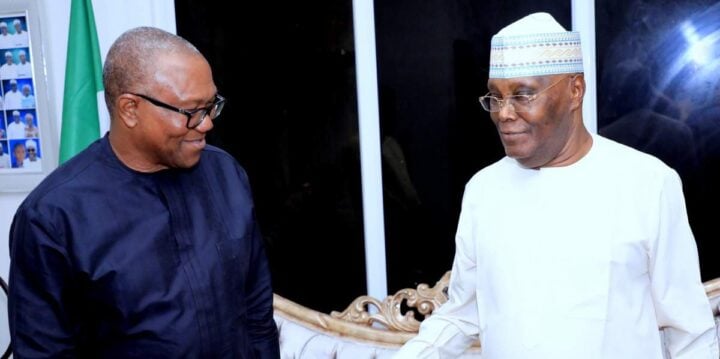

The African Democratic Congress (ADC) has openly expressed concern over the apparent lack of collaboration between former Vice President Atiku Abubakar and Peter Obi, the Labour Party’s presidential candidate in the 2023 general elections, as political actors begin positioning themselves ahead of the 2027 polls. The party said while the situation may not yet amount to a crisis, it remains a significant issue that cannot be ignored by opposition forces seeking to mount a credible challenge in the next election cycle.
Speaking on The Morning Show, a programme aired on Arise Television on Friday, the ADC’s spokesperson, Bolaji Abdullahi, acknowledged that the failure of major opposition figures to work together raises questions about unity and strategy ahead of 2027. Responding to a question on whether the absence of cooperation between Obi and Atiku poses a threat to Nigeria’s democracy, Abdullahi described the situation as a “challenge” and a “conundrum,” noting that it is an issue the party is watching closely.
“I may not describe the situation in such superlative terms to say that it’s the greatest threat to democracy at the moment,” Abdullahi said. “But is it a conundrum? Yes. Is it a challenge? Yes. Is it something we are concerned about? Yes.”
Despite these concerns, Abdullahi stressed that the ADC is not currently focused on discussions around its presidential ticket. According to him, the party’s immediate priority is building strong and functional structures across the country that would enable it to contest elections effectively at all levels. He explained that the ADC is concentrating on establishing a visible and operational presence in all 36 states of the federation and the Federal Capital Territory.
Related News

Henry Seriake Dickson Defects from PDP to Newly Formed Nigeria Democratic Congress
Senator Henry Seriake Dickson has formally defected from the Peoples Democratic Party (PDP) to the newly registered Nigeria Democratic Congress…

Hon. Sarah Ivie Adidi Receives “Her Excellence Award” During International Women’s Day Event in Abuja
Reps aspirant Sarah Ivie Adidi has been honoured with the 2026 “Her Excellence Award” during an event marking International Women’s…
Governor Peter Mbah Urges Ndigbo to Return to Strategic Politics
Peter Mbah, Governor of Enugu State, has urged the Igbo political class to return to what he described as “strategic…
“Nobody in the ADC at this time is having conversations about who the presidential candidates will be,” he said. “We have so much work to do — to establish our real presence and be in a position to contest elections in all 36 states and the FCT.”
He further clarified that the party’s internal focus goes beyond the political calculations of Atiku Abubakar and Peter Obi, noting that several individuals have shown interest in contesting the presidency under the ADC platform. According to him, the idea that the party’s future revolves solely around the two political heavyweights is inaccurate.
“It’s not just about Atiku Abubakar and Peter Obi,” Abdullahi said. “There are other people who are also interested in contesting the presidential race, and we have to make allowance for that.”
On how the party plans to eventually select its flag bearer, Abdullahi said the ADC would first attempt to build consensus among stakeholders when the time comes. He explained that consensus remains an option, but if that approach fails, the party would not hesitate to open the process and allow all interested aspirants to contest in a primary election.
“We know that it is an issue we have to deal with,” he said. “The most important thing is that when we get to that point, we try to engineer a consensus. But if we are not able to reach a consensus, then we’ll possibly just open it up for everyone to contest.”
The ADC’s position comes amid reports of ongoing coalition talks among opposition parties and political leaders. Earlier in the month, Peter Obi reportedly expressed concerns that the ADC-led coalition was struggling due to unresolved questions around zoning and the rotation of key political offices. Obi has yet to formally register as a member of the ADC, while Atiku Abubakar has already obtained his membership card, a development that has fueled speculation about the direction of the party.
Abdullahi has previously urged Obi to take a clear position on joining the ADC, stressing that the party is not yet at the stage of formally adopting zoning arrangements. As political calculations intensify ahead of 2027, observers say the ability—or failure—of key opposition figures to work together may play a decisive role in shaping the next general election.