Bashir El-Rufai Defends Father Amid Phone-Tapping Controversy
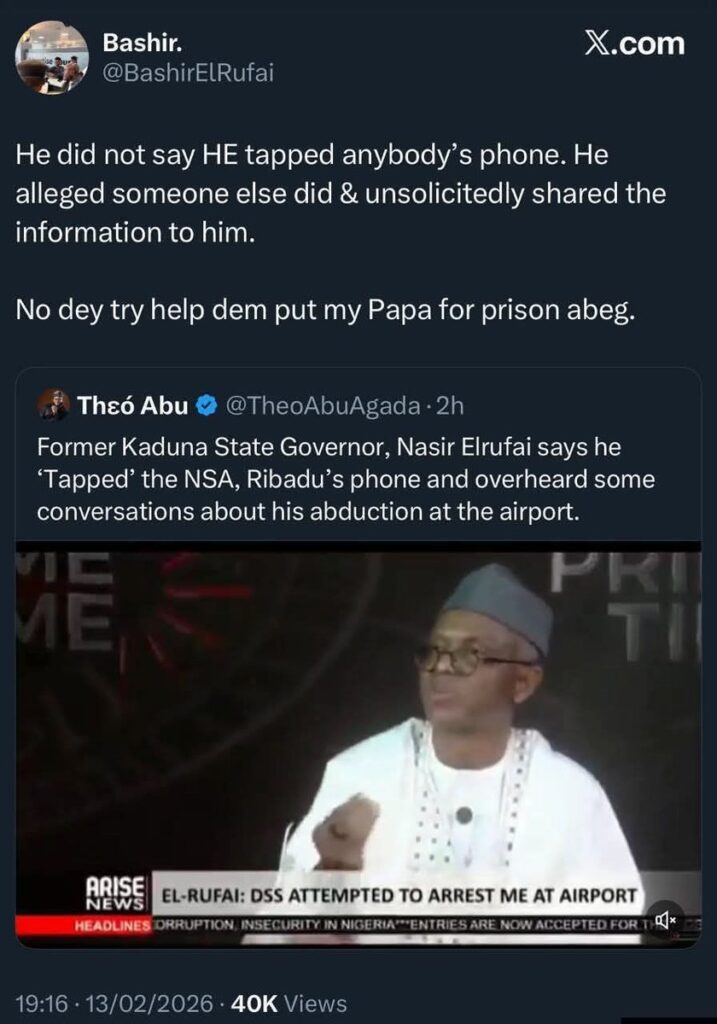

Bashir El-Rufai, son of former Kaduna State governor Nasir El-Rufai, has publicly defended his father following controversy surrounding remarks suggesting that a phone belonging to a top government official had been tapped.
The controversy emerged after a recent public appearance in which Nasir El-Rufai made comments interpreted by some observers as an admission that he or his associates had intercepted private communications. The remarks quickly gained traction across political circles and social media, sparking speculation about potential legal and security implications.
Responding to the growing debate, Bashir El-Rufai clarified that his father did not personally admit to tapping any phone. According to him, the former governor merely alleged that a third party had carried out such an action and voluntarily shared the information with him.
“My father did not say he tapped anybody’s phone,” Bashir said in a statement circulated online. “He alleged someone else did and unsolicitedly shared the information with him.” He also appealed to the public and political actors not to misrepresent his father’s comments or escalate the situation unnecessarily.
Related News

Henry Seriake Dickson Defects from PDP to Newly Formed Nigeria Democratic Congress
Senator Henry Seriake Dickson has formally defected from the Peoples Democratic Party (PDP) to the newly registered Nigeria Democratic Congress…

Hon. Sarah Ivie Adidi Receives “Her Excellence Award” During International Women’s Day Event in Abuja
Reps aspirant Sarah Ivie Adidi has been honoured with the 2026 “Her Excellence Award” during an event marking International Women’s…
Governor Peter Mbah Urges Ndigbo to Return to Strategic Politics
Peter Mbah, Governor of Enugu State, has urged the Igbo political class to return to what he described as “strategic…
The clarification appears aimed at countering interpretations that could suggest direct involvement by Nasir El-Rufai in any unlawful surveillance activity. Under Nigerian law, unauthorized interception of private communications can carry serious legal consequences, particularly when it involves public officials or national security matters.
While Bashir did not specify who allegedly carried out the interception referenced in his father’s remarks, he emphasized that his father should not be implicated in any wrongdoing based on what he described as a misunderstanding or misrepresentation of the original statement.
The controversy has drawn widespread attention within Nigeria’s political landscape, with analysts noting that the issue touches on broader concerns about surveillance, security, and political rivalry. Some commentators view the development as part of ongoing political tensions among prominent figures, especially as the country moves closer to future electoral cycles.
At the centre of the speculation is the possibility that the alleged intercepted communication involved high-ranking government officials, including the National Security Adviser, Nuhu Ribadu. However, no official confirmation has been issued regarding the identities of individuals referenced in the disputed comments.
Political observers say the situation highlights the sensitivity surrounding public statements by influential figures, particularly when they involve national security matters. Analysts also note that the rapid spread of interpretations through social media has amplified the controversy and increased pressure on those involved to clarify their positions.
Despite the growing public debate, there has been no formal announcement of any investigation or legal proceedings related to the matter. Bashir El-Rufai’s intervention appears intended to de-escalate tensions and prevent further speculation about his father’s role.
Nasir El-Rufai, who previously served as governor of Kaduna State and held various federal positions, remains an influential voice in Nigerian politics. His comments and political alignments continue to attract significant attention, especially amid shifting alliances and emerging political narratives.
As discussions continue, observers say the incident underscores the need for clarity and caution in public discourse involving security-related claims. Whether the controversy will lead to further political or legal developments remains uncertain, but for now, the former governor’s camp insists that his remarks have been misunderstood.