Community Leaders from Ogbia Kingdom Endorse Tinubu for 2027, Cite Development and Inclusive Governance
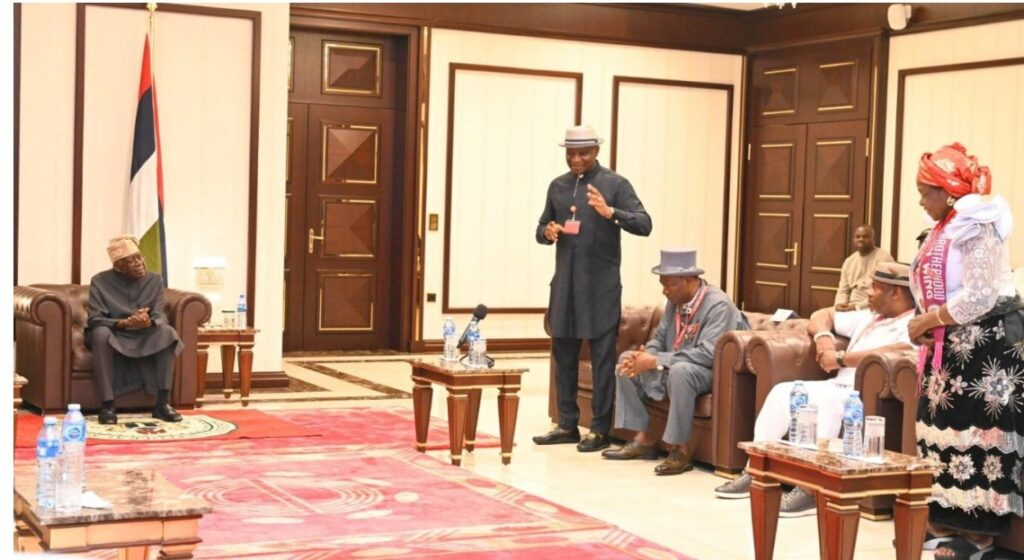

Leaders of Ogbia Kingdom, spanning parts of Bayelsa and Rivers states, have formally called on President Bola Ahmed Tinubu to contest the 2027 presidential election, declaring their readiness to support his re-election bid. The endorsement was made during a courtesy visit by a delegation of traditional rulers and community leaders to the State House in Abuja, marking a significant political gesture from the home community of former President Goodluck Jonathan.
The delegation was led by Samuel Ogbuku, Managing Director of the Niger Delta Development Commission (NDDC), while the group’s position was articulated by a traditional ruler, Collins Daniel. Speaking on behalf of the Ogbia Kingdom, Daniel said the decision to back Tinubu for a second term was informed by what the community described as inclusive leadership and tangible development interventions in the Niger Delta region under the current administration.
According to him, the visit was primarily to express appreciation for the confidence President Tinubu has shown in Ogbia indigenes through appointments and re-appointments to strategic national positions. He described these appointments as a strong signal of trust and inclusion, noting that they have reinforced the community’s belief in the administration’s governance approach.
Among those acknowledged were Moore Abraham Aseima Adumein, a justice of the Supreme Court; Samuel Ogbuku, Managing Director of the NDDC; Tonye Okio, a commissioner at the Federal Character Commission representing Bayelsa State; and Fernandez Marcus-Obiene, Special Assistant to the President on Justice Reform and ICT, Digital and Innovative Technology. Daniel said these appointments had strengthened the confidence of the Ogbia people in the federal government and demonstrated a willingness to involve Niger Delta indigenes in national decision-making.
Related News
Henry Seriake Dickson Defects from PDP to Newly Formed Nigeria Democratic Congress
Senator Henry Seriake Dickson has formally defected from the Peoples Democratic Party (PDP) to the newly registered Nigeria Democratic Congress…

Hon. Sarah Ivie Adidi Receives “Her Excellence Award” During International Women’s Day Event in Abuja
Reps aspirant Sarah Ivie Adidi has been honoured with the 2026 “Her Excellence Award” during an event marking International Women’s…
Governor Peter Mbah Urges Ndigbo to Return to Strategic Politics
Peter Mbah, Governor of Enugu State, has urged the Igbo political class to return to what he described as “strategic…
The traditional ruler also commended the performance of the NDDC under Ogbuku, stating that communities within Ogbia Kingdom and the wider Niger Delta had experienced noticeable improvements in infrastructure and human capital development since his appointment in August 2023. He highlighted the provision of solar-powered street lighting across several communities, noting that improved lighting had boosted economic activities and contributed to a reduction in insecurity.
In addition to solar projects, the delegation cited road construction, ecological intervention projects, upgraded health facilities, and youth empowerment programmes as part of the NDDC’s achievements. Special mention was made of Project HOPE, an initiative focused on empowering young people in areas such as technology, agriculture, arts, and green energy.
Daniel further praised the president for ongoing and planned federal projects in Ogbia, including the Oloibiri Oil Museum and Research Centre, the rehabilitation of sections of the Ogbia–Nembe–Brass Road, and the construction of the Otuogori–Otuegwe Bridge along the Ekole River. He described Ogbia as the cradle of Nigeria’s oil industry, recalling that crude oil was first discovered in commercial quantities there in 1956.
Beyond its oil history, the delegation referenced Ogbia’s contributions to national unity, citing the role of leaders such as the late Melford Okilo in pre-independence political alliances and former President Goodluck Jonathan’s 2015 concession of defeat as examples of sacrifice for a united Nigeria. According to Daniel, these moments reflected the community’s long-standing commitment to national stability and cohesion.
While reaffirming their support, the leaders also presented development requests to the federal government. These included the establishment of an institute of energy and petroleum studies in Ogbia, partnership on the Akaba–Emadike Road project, and shoreline protection for coastal communities threatened by erosion.
In his response, President Tinubu thanked the delegation and assured them that his administration would continue to collaborate with Niger Delta indigenes in government to advance development in the region. He acknowledged the history of neglect in the Niger Delta but emphasized the need to focus on present opportunities to drive progress.
The visit and endorsement have since generated varied reactions among the public, reflecting ongoing debates about governance, development, and political alignment ahead of the 2027 general elections.