Concerned Northern Elders Reject NEF Position on FIRS, Declare Support for Tinubu’s Economic Reforms


The Concerned Northern Elders have rejected and criticised recent comments credited to the Northern Elders Forum (NEF) regarding the activities of the Federal Inland Revenue Service (FIRS), declaring that such views do not reflect the collective position or long-term aspirations of the North. The group made its position known in a press statement issued on Tuesday, signalling a growing internal divergence among northern socio-political voices over economic reforms and governance priorities.
In the statement, signed by Dr. Nasir Manguno, the elders said they were compelled to speak out in the interest of truth, responsibility, and historical accountability. According to the group, remaining silent in the face of what it described as deliberate distortion of facts would amount to complicity. They argued that the alleged NEF position opposing the FIRS, its Executive Chairman, and the broader reform agenda of President Bola Ahmed Tinubu misrepresents the conscience of northern elders and undermines the region’s progressive expectations.
The Concerned Northern Elders accused the NEF of losing its moral authority over time, stating that it has gradually shifted from a body of collective wisdom to what they described as a platform for political grievances and sponsored opposition narratives. They maintained that elder statesmanship should be anchored on integrity, foresight, and national interest rather than nostalgia for ineffective systems or a sense of entitlement rooted in the past.
Related News

Henry Seriake Dickson Defects from PDP to Newly Formed Nigeria Democratic Congress
Senator Henry Seriake Dickson has formally defected from the Peoples Democratic Party (PDP) to the newly registered Nigeria Democratic Congress…

Hon. Sarah Ivie Adidi Receives “Her Excellence Award” During International Women’s Day Event in Abuja
Reps aspirant Sarah Ivie Adidi has been honoured with the 2026 “Her Excellence Award” during an event marking International Women’s…
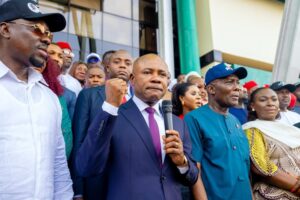
Governor Peter Mbah Urges Ndigbo to Return to Strategic Politics
Peter Mbah, Governor of Enugu State, has urged the Igbo political class to return to what he described as “strategic…
In defending the FIRS, the group commended the agency’s current leadership, noting that it has consistently exceeded revenue targets while strengthening non-oil revenue mobilisation. They highlighted the deployment of technology and data-driven systems to reduce leakages and improve tax compliance, adding that recent reforms have ensured that influence and privilege no longer translate into tax exemptions. According to the elders, these achievements are verifiable and demonstrate what is possible when competence and accountability replace complacency.
The statement further argued that resistance to these reforms is largely driven by individuals and interests unsettled by transparency and efficiency. The group insisted that a fair and effective tax system is central to national development and should not be politicised or portrayed as punitive. They stressed that no country achieves sustainable growth by shielding elites from responsibility or placing the financial burden of governance solely on the poor.
On President Tinubu’s broader economic agenda, the elders said the administration inherited an economy weakened by subsidy dependency, opacity, and selective compliance. They praised the President for pursuing what they described as difficult but necessary reforms, noting that courage, rather than convenience, was required to address longstanding structural weaknesses. According to the group, revenue reform is a foundational pillar of nation-building and economic recovery.
The Concerned Northern Elders also expressed support for the Memorandum of Understanding entered into by the FIRS to strengthen inter-agency collaboration, harmonise data systems, and eliminate duplication. They argued that policies aimed at strengthening institutions, improving transparency, and enhancing revenue efficiency are in the best interest of both the North and the country as a whole.
Addressing the political undertones surrounding the controversy, the group warned against what it described as the “politics of sabotage.” They claimed that renewed attacks on the FIRS coincided with political realignments by opposition interests seeking to mobilise the North against reform efforts. The elders cautioned that the region should not allow itself to be used as a tool for partisan objectives.
In concluding, the group reaffirmed its support for the Executive Chairman of the FIRS, President Tinubu’s economic reform agenda, and public officials committed to national interest over elite comfort. They maintained that the true priorities of the North remain job creation, infrastructure development, education, and accountability, and that history ultimately favours reformers rather than obstructionists.