Enugu Allocates ₦10 Billion for Phase One of 135.4km Rail Line in Ambitious 2026 Development Plan
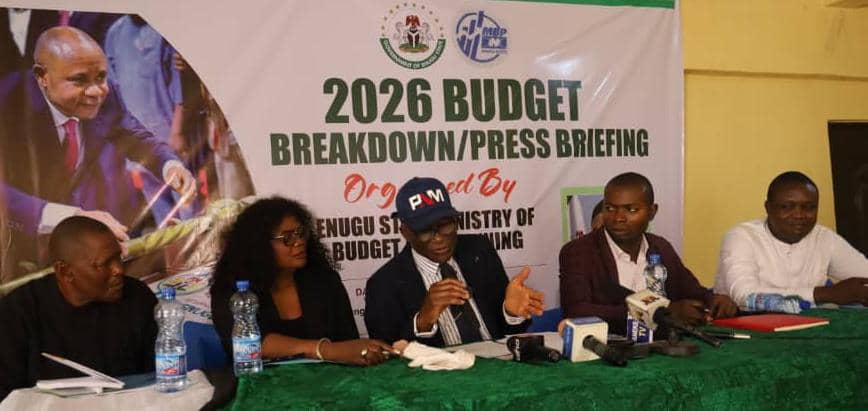

The Enugu State Government has announced a ₦10 billion allocation for the first phase of its proposed 135.4km standard-gauge railway, marking one of the most ambitious transport infrastructure projects ever initiated by the state. The announcement came during a press briefing held by the Commissioner for Budget and Planning, Barrister Chris-Roberts Ozongwu, at the NUJ Press Centre in Enugu.
This funding is part of Governor Peter Mbah’s newly presented ₦1.62 trillion 2026 budget—dubbed the “Budget of Renewed Momentum”—which sets a historic record for the South East. The budget represents a 66.5% jump from the revised ₦971 billion 2025 budget, driven by the administration’s aggressive push for infrastructure-led economic transformation.
Of the total budget, ₦1.3 trillion is earmarked for capital expenditure (80%), while ₦321.2 billion goes to recurrent costs (20%). According to the commissioner, this ratio underscores the administration’s commitment to fast-tracking large-scale development projects and positioning Enugu as a regional economic hub.
Rail to Connect Enugu to Neighbouring States
Breaking down the allocation, Ozongwu explained that the 135.4km rail line is central to Governor Mbah’s campaign pledge to build a fully integrated, multimodal transport network. The system is expected to include rail, tram lines, and inland water routes—providing alternatives to road transport and reducing pressure on the state’s roadways.
Beyond improving intra-state mobility, the rail line is designed to extend towards the borders of neighbouring states, enhancing connectivity within the South East and enabling free movement of people, goods, and services. The commissioner emphasized that this approach supports the region’s economic goals while improving logistics efficiency.
Massive Expansion for Enugu Air
The commissioner also revealed major plans for Enugu Air, the state-owned airline launched in July 2025 with three aircraft. The airline, which he described as “highly lucrative,” is expected to expand its fleet to 20 aircraft by the end of 2025.
Related News
Aerial Footage Shows Progress on Sokoto–Badagry Super Highway Construction
New aerial footage circulating online has revealed ongoing construction work on the proposed Sokoto–Badagry Super Highway, a major infrastructure project…
Kaduna State Government Takes Over Ahmadu Bello Stadium, Begins Major Reconstruction
The Kaduna State Government has officially taken over ownership of the iconic Ahmadu Bello Stadium from the Federal Government, following…
Umahi Inspects Ongoing Rehabilitation of Lagos–Ota–Abeokuta Expressway
Minister of Works David Umahi has inspected the rehabilitation of the Lagos–Ota–Abeokuta Expressway, describing the project as a priority infrastructure…
Three additional planes will be added before the close of 2025, bringing the current fleet to six, while a more aggressive rollout of 14 more aircraft will follow. This expansion is tied to the state’s broader vision of transforming Enugu into a West African aviation and logistics hub.
Additional Major Transport Investments
Two other major transport projects will each receive ₦10 billion:
-
Akanu Ibiam International Airport Concession: An equity contribution to deepen the state’s involvement in the airport’s concession and boost its international capacity.
-
Enugu Vehicle Manufacturing & Taxi Assembly Programme: The government plans to procure and assemble 2,100 taxis within the state. These vehicles will support the Youth Empowerment Scheme and the Distress Response Squad (DRS), the state’s specialized police unit.
Ozongwu explained that this initiative is designed to stimulate local manufacturing, create jobs, and strengthen public safety operations.
Confidence in Budget Performance
The commissioner expressed strong confidence that the 2026 budget would surpass the performance of the 2025 budget. He noted that the administration has already achieved an 85% implementation rate this year—an achievement he attributed to a private-sector-driven governance model focused on efficiency and results.
“We have the personnel, the acumen, and the indices needed to deliver 90% performance next year,” Ozongwu said. “There is a feel-good factor in Enugu. Investors can come in with confidence—their investments will be protected, and returns will be significant. This state is ready for takeoff.”
He also highlighted the allocation of 51.1% of the budget to the economic sector and 40.1% to the social sector as further proof of the government’s balanced approach to growth and human development.
Mixed Public Reactions
While many residents applauded the vision—especially the rail and aviation components—others expressed skepticism, questioning the number of future “phases” and whether the ambitious plans would see full implementation. Some commenters also demanded clarity on the specific rail routes, while a few doubted the feasibility of such projects under Nigeria’s prevailing economic conditions.
Nevertheless, supporters of the governor praised his bold approach, urging other South East and Southern states to adopt similar strategies rather than limit development to smaller-scale projects.