Ilorin–Jebba–Mokwa Road Project Reaches 81% Completion Amid Mixed Public Reactions
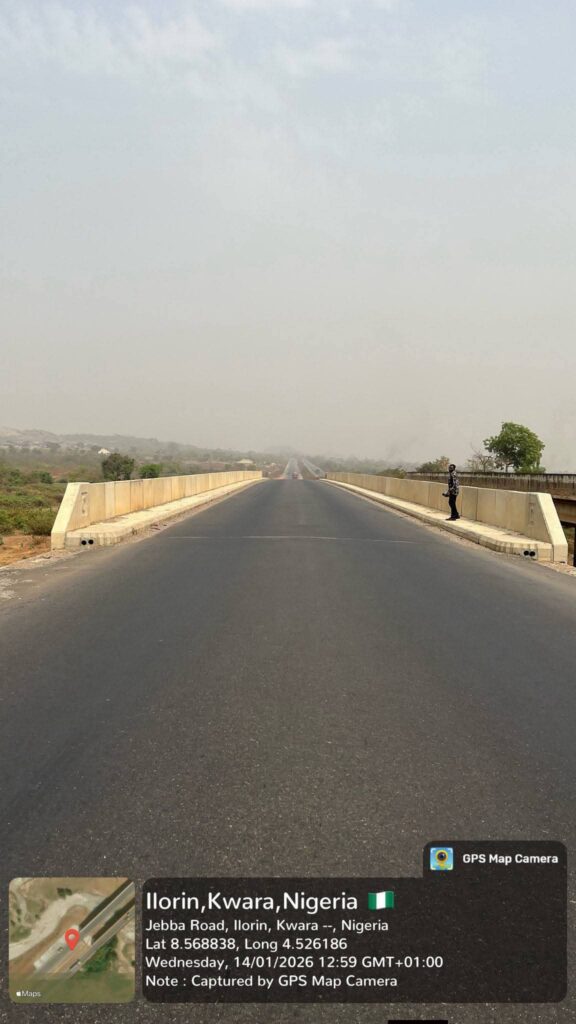

The Federal Government has announced significant progress on the Ilorin–Jebba–Mokwa Road project, revealing that construction has reached approximately 81 percent completion. According to official updates, about 80 kilometres of the road have already been laid with a wearing course, marking a major milestone on one of Nigeria’s most strategic transport corridors connecting the South-West to the North-Central and Northern regions.
The Ilorin–Jebba–Mokwa Road is widely regarded as a critical economic artery, serving commercial traffic, long-haul transporters, and commuters travelling between southern and northern parts of the country. Government officials state that once completed, the road will enhance safety, significantly reduce travel time, and improve regional connectivity, particularly for trade and agricultural supply chains.
The project forms part of the Federal Government’s broader infrastructure renewal drive, which prioritises the rehabilitation and expansion of key highways across the country. Commendations have been directed at President Bola Ahmed Tinubu and the Minister of Works, Professor David Umahi, for sustaining construction momentum and pushing the project toward completion.
Related News
Aerial Footage Shows Progress on Sokoto–Badagry Super Highway Construction
New aerial footage circulating online has revealed ongoing construction work on the proposed Sokoto–Badagry Super Highway, a major infrastructure project…
Kaduna State Government Takes Over Ahmadu Bello Stadium, Begins Major Reconstruction
The Kaduna State Government has officially taken over ownership of the iconic Ahmadu Bello Stadium from the Federal Government, following…
Umahi Inspects Ongoing Rehabilitation of Lagos–Ota–Abeokuta Expressway
Minister of Works David Umahi has inspected the rehabilitation of the Lagos–Ota–Abeokuta Expressway, describing the project as a priority infrastructure…
Supporters of the administration have described the progress as evidence of renewed focus on infrastructure delivery, noting that road construction remains one of the most visible indicators of government performance. Some road users and observers have praised the quality of completed sections, describing them as durable and well-engineered, especially given the heavy use by trailers and articulated vehicles.
However, the announcement has also sparked debate, particularly over the attribution of credit for the project. Critics argue that substantial portions of the road were initiated or completed under previous administrations, especially during the tenure of former President Muhammadu Buhari. Some commentators have pointed to the Presidential Infrastructure Tax Credit Scheme as the original funding mechanism, stressing that funds for the road were already earmarked before the current administration took office.
Others contend that while work may have begun earlier, continuity and completion are what ultimately matter. They argue that infrastructure projects in Nigeria often stall due to changes in government, and that sustained progress should be acknowledged regardless of when the project was initiated.
Beyond questions of credit, broader concerns have been raised about the lived experience of road users, particularly around the Mokwa axis. Some residents and frequent travellers claim that certain stretches remain in poor condition, with potholes and diversions still posing safety risks. There have also been renewed calls for enhanced security along the corridor, which has previously been identified as a high-risk zone for kidnapping and other criminal activities.
The discussion has further expanded into a wider critique of government priorities. While acknowledging improvements in road construction, some Nigerians argue that infrastructure gains have not translated into economic relief for the average citizen. Issues such as inflation, unemployment, power supply challenges, and insecurity continue to dominate public discourse, with critics questioning whether road projects alone can offset broader economic hardship.
Despite the controversy, there is general agreement on the importance of completing the Ilorin–Jebba–Mokwa Road. As a major transit route for goods and passengers, its full rehabilitation is expected to support commerce, reduce vehicle operating costs, and improve safety outcomes. Stakeholders have urged the government to ensure that the remaining 19 percent of the project is delivered promptly, transparently, and to high engineering standards.
As construction progresses toward completion, attention is likely to remain focused not only on timelines and quality, but also on accountability, maintenance plans, and the real-world impact on communities and businesses that depend on the route daily.