I’m Still in Labour Party, but Nobody Knows Tomorrow — Alex Otti Speaks on Defection Rumours
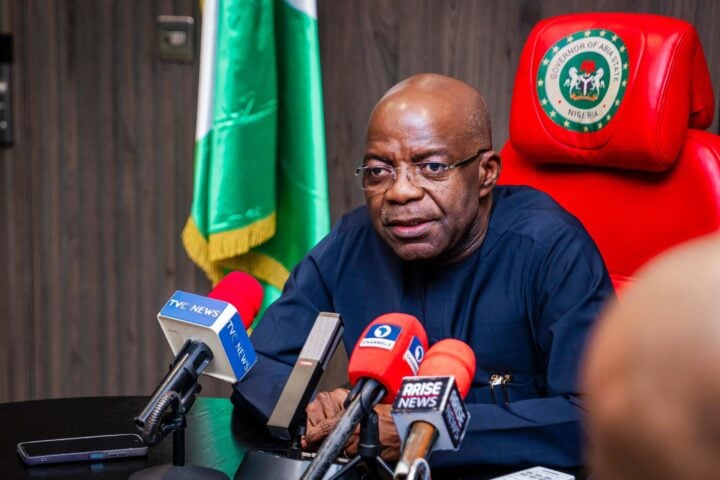

Abia State Governor, Alex Otti, has stated that he remains a member of the Labour Party (LP), the political platform that brought him to power in the 2023 governorship election, even as he acknowledged the uncertainty that defines Nigeria’s political landscape. His comments come at a time of heightened political tension, marked by mass defections of opposition politicians to the ruling All Progressives Congress (APC) and deep internal divisions within the Labour Party itself.
Governor Otti made the remarks on Thursday during his monthly media interaction, where journalists questioned him on the lingering leadership crisis rocking the Labour Party and the growing speculation that he might consider dumping the party ahead of future elections. While affirming his present loyalty to the LP, the governor pointedly added that “nobody knows tomorrow,” a statement that has since generated widespread political commentary.
“I am still in the Labour Party,” Otti said. “We are on the right side. We have maintained that Abure’s tenure has expired, and we went to court, which affirmed that. The court judgment confirmed that his tenure has expired and advised people to obey court decisions to save the courts from unnecessary troubles.”
Otti was referring to the long-running dispute over the leadership of the Labour Party, which has seen rival factions lay claim to the party’s national structure. The crisis has pitted the Julius Abure-led faction against another group headed by former finance minister Nenadi Usman, with both sides seeking legal and institutional recognition.
Related News

Henry Seriake Dickson Defects from PDP to Newly Formed Nigeria Democratic Congress
Senator Henry Seriake Dickson has formally defected from the Peoples Democratic Party (PDP) to the newly registered Nigeria Democratic Congress…

Hon. Sarah Ivie Adidi Receives “Her Excellence Award” During International Women’s Day Event in Abuja
Reps aspirant Sarah Ivie Adidi has been honoured with the 2026 “Her Excellence Award” during an event marking International Women’s…

Governor Peter Mbah Urges Ndigbo to Return to Strategic Politics
Peter Mbah, Governor of Enugu State, has urged the Igbo political class to return to what he described as “strategic…
Last week, the Federal High Court in Abuja delivered a major ruling in the dispute, declaring the Nenadi Usman-led national caretaker committee as the authentic leadership of the Labour Party. In his judgment, the presiding judge, Justice Peter Lifu, also directed the Independent National Electoral Commission (INEC) to recognise the Usman-led faction as the legitimate authority of the party. Governor Otti belongs to this faction, which has consistently argued that Abure’s tenure had lapsed.
Despite the court’s decision, the Abure-led group has rejected the ruling and announced plans to challenge it at the Court of Appeal, ensuring that the internal crisis remains far from resolved. This continued uncertainty has raised concerns among party stakeholders about the Labour Party’s stability ahead of future elections, particularly in states where it currently holds power.
Addressing questions about his political future, Otti said the current period was not an election season and stressed that his immediate focus remained on governance. “We are not in an election period,” he explained. “If an election comes, we will still run under the Labour Party, but nobody knows tomorrow. But today, I am still in the Labour Party.”
His comments have been widely interpreted as cautious and strategic rather than an outright declaration of intent to defect. However, in Nigeria’s fluid political environment—where party switching is common, especially as elections draw closer—such statements often carry deeper political implications.
Otti’s remarks come amid a wave of defections by opposition governors and lawmakers to the APC, a trend that has reshaped political alignments across the country. Analysts note that internal party disputes, concerns about legal recognition, and calculations about electoral survival often drive such defections.
Public reaction to Otti’s statement has been mixed. While some supporters praised him for his honesty and pragmatism, others expressed concern that his words signal a possible exit from the Labour Party. Online discussions have been dominated by speculation about whether he could move to another opposition party or even align with the ruling APC, though the governor himself has made no such declaration.
For now, Alex Otti maintains that he is firmly within the Labour Party, aligning himself with the faction recognised by the court. Whether his “nobody knows tomorrow” remark proves to be a simple acknowledgment of political uncertainty or a prelude to a future realignment remains to be seen.