Kwankwasiyya Movement Urges Kwankwaso, Abba Yusuf to Lead Defection Into APC
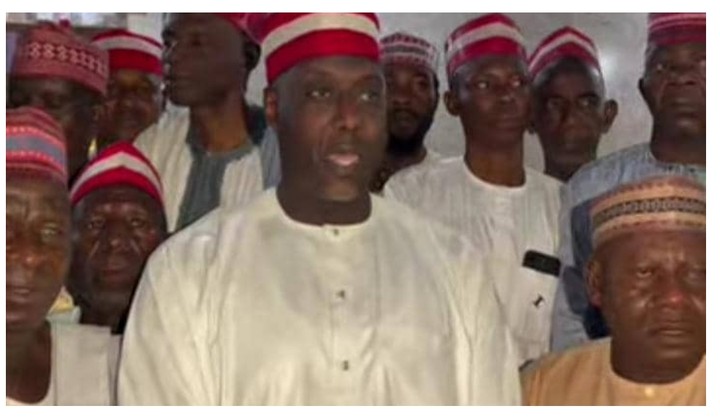

Supporters of Rabiu Musa Kwankwaso, former governor of Kano State and national leader of the New Nigeria Peoples Party (NNPP), have announced that they are considering defecting to the All Progressives Congress (APC), Nigeria’s ruling party. The supporters, who operate under the banner of the Kwankwasiyya movement, say the proposed defection is driven by strategic political considerations and what they describe as the broader interest of Kano State.
The appeal was made public following a meeting held in Rogo Local Government Area of Kano State, which brought together party stakeholders, including the local government chairman, councillors, and grassroots party leaders. The meeting was convened to review the current political climate and assess the future direction of the Kwankwasiyya movement and the NNPP in Kano.
Speaking on behalf of the group, Abdullahi Rogo, Director-General of the Protocol Directorate at the Kano State Government House, disclosed that members unanimously resolved to appeal to both Governor Abba Kabir Yusuf and Kwankwaso to lead them into the APC. Rogo addressed supporters in a video message delivered in Hausa, which later circulated widely on social media.
According to Rogo, the decision was informed by the belief that Kwankwaso’s long-standing presidential ambition would stand a better chance within the APC, given the party’s national reach and control of the federal government. He stressed that the move was not a rejection of the Kwankwasiyya ideology but rather an attempt to reposition it within a more politically advantageous platform.
Related News

Henry Seriake Dickson Defects from PDP to Newly Formed Nigeria Democratic Congress
Senator Henry Seriake Dickson has formally defected from the Peoples Democratic Party (PDP) to the newly registered Nigeria Democratic Congress…

Hon. Sarah Ivie Adidi Receives “Her Excellence Award” During International Women’s Day Event in Abuja
Reps aspirant Sarah Ivie Adidi has been honoured with the 2026 “Her Excellence Award” during an event marking International Women’s…
Governor Peter Mbah Urges Ndigbo to Return to Strategic Politics
Peter Mbah, Governor of Enugu State, has urged the Igbo political class to return to what he described as “strategic…
“During the meeting, we unanimously agreed to appeal to the Governor of Kano State, Alhaji Abba Kabir Yusuf, and the national leader of our great movement, Engineer Rabiu Musa Kwankwaso, to lead us in defecting to the All Progressives Congress,” Rogo said. “This decision was taken in the best interest of Kano State’s development and the political progress of Engr. Rabiu Musa Kwankwaso.”
He added that members of the NNPP and the Kwankwasiyya movement in Rogo Local Government Area believe that aligning with the APC would enhance Kano’s access to federal opportunities and influence national decision-making. The meeting was reportedly led by Jibril Falgore, Speaker of the Kano State House of Assembly, lending further political weight to the discussions.
Rogo was careful to note that the proposed defection does not imply an abandonment of the Kwankwasiyya movement or its core principles. Instead, he said the group expects Kwankwaso and Governor Yusuf to take the lead, arguing that their guidance is essential to maintaining unity and direction among supporters.
The development comes against the backdrop of Kwankwaso’s complex political journey across major parties. The former governor was previously a member of the APC before defecting to the Peoples Democratic Party (PDP) following prolonged political disputes with his successor and former deputy, Abdullahi Ganduje. Kwankwaso contested the 2019 presidential primaries on the PDP platform before leaving the party and joining the NNPP in 2022, under which he contested the 2023 presidential election.
His supporters, widely regarded as loyal to his political brand rather than any single party, have followed him across these political transitions. The latest appeal by the Kwankwasiyya movement has therefore reignited debate about party loyalty, ideology, and the increasing trend of defections in Nigeria’s political landscape.
Notably, the call for defection contrasts with Kwankwaso’s earlier criticism of politicians who switch parties after gaining power. In May, he publicly condemned defections driven by what he described as personal ambition rather than principle, a position that has now resurfaced in public discussions surrounding the latest development.
The appeal has generated mixed reactions among political observers and party supporters. While some see it as a pragmatic move in a political environment increasingly dominated by the APC, others have raised concerns about Nigeria drifting toward a one-party system and the erosion of ideological distinctions between parties.
As of now, neither Kwankwaso nor Governor Abba Yusuf has publicly responded to the appeal. However, the move underscores the fluid nature of Nigerian politics as parties and political movements position themselves ahead of future electoral contests, particularly the 2027 general elections.