Ndume Urges President Tinubu to Withdraw Ambassadorial Nominee List Over Federal Character Concerns
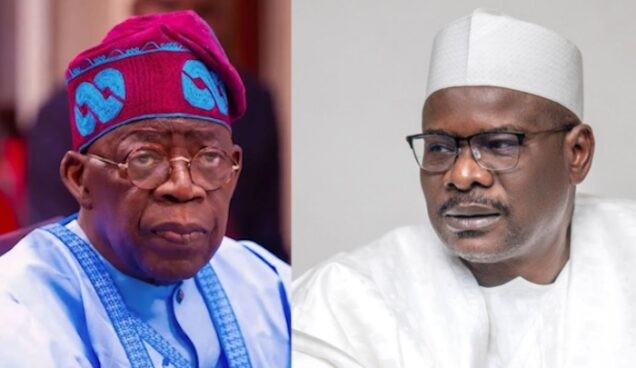

Former Senate Leader and Senator representing Borno South, Ali Ndume, has publicly urged President Bola Ahmed Tinubu to withdraw the latest list of ambassadorial nominees submitted to the Senate for screening and confirmation. Ndume made the appeal in Abuja on Thursday, arguing that the list, as currently composed, contravenes the Federal Character principle mandated by the Nigerian Constitution.
Ndume’s primary concern centers on what he described as a glaring imbalance in the geographical distribution of nominees. According to the breakdown, several states received multiple slots—some as many as three or four—while others received none. Gombe State, for instance, had no nominee on the list. Adding to the controversy is the inclusion of Senator Adamu Garba Talba as Yobe State’s nominee, despite his death in July 2025. The senator’s name still appeared on the list read by the Senate President, raising questions about due diligence and internal review within the executive branch.
A regional analysis of the list further intensified Ndume’s objections. The Northeast, consisting of six states, has a total of only seven nominees, while the Southwest alone has fifteen. The Northwest and Southeast have thirteen and nine nominees, respectively. The North Central region has ten, while the South South accounts for twelve. For Ndume, these disparities violate not only equity but the constitutional requirement for representation.
Citing Section 14(3) of the 1999 Constitution (as amended), Ndume reminded the presidency that “the composition of the Government of the Federation or any of its agencies… shall reflect the federal character of Nigeria.” The provision exists to promote national unity, prevent dominance by a few states or groups, and ensure that no part of the country feels marginalized.
Ndume expressed a deep concern that the nominee list, if allowed to stand, could erode national cohesion at a delicate moment in Nigeria’s political and economic trajectory. “My sincere appeal to President Tinubu is to withdraw this list,” he stated. “At this critical time in the life of his administration, he should avoid missteps that would endanger national unity and promote ethnic distrust.”
The senator also emphasized that his call was not born out of political rivalry or personal grievance. Instead, he insisted that his appeal stems from his experience as a long-standing legislator and his personal knowledge of President Tinubu as a leader who understands Nigeria’s diversity. “I know him to be a cosmopolitan leader who is at home with every segment and stakeholder in the country,” Ndume noted. “He should present a fresh set of nominees that aligns with the spirit of the Constitution.”
Related News
Tinubu Approves Posting of Four Ambassador-Designates to United States, UK, France, and Turkey
President Bola Ahmed Tinubu has approved the posting of four Nigerian ambassador-designates to key foreign missions, including the United States,…

US ‘Boots on the Ground’ in Nigeria Will Depend on Defence Ministry’s Advice — Tuggar
Nigeria’s Foreign Affairs Minister, Yusuf Tuggar, has said any decision to allow United States troops to operate on Nigerian soil…

Nigeria Grants Asylum to Guinea-Bissau Presidential Candidate Amid Heightened Political Tension
The Federal Government of Nigeria has granted temporary asylum to Guinea-Bissau opposition presidential candidate Fernando Dia Da Costa, offering him…
The Senate President had earlier read the list during plenary and referred it to the Senate Committee on Foreign Affairs for legislative processing. If the list progresses through screening without withdrawal, senators will retain the power to reject or amend the nominations. Some members of the public argue that Ndume should mobilize Senate opposition rather than appeal publicly to the President.
Public Reactions: Mixed Outrage, Sarcasm, and Political Jabs
Following the release of Ndume’s statement, online platforms erupted with diverse and often heated opinions.
Some commenters strongly supported Ndume, accusing the Tinubu administration of cronyism, tribal favoritism, and incompetence—especially with the inclusion of a deceased nominee. Others mocked the situation, expressing disbelief that such an oversight could occur at the highest levels of government.
Many critics accused Tinubu of rewarding allies with questionable histories, describing the list as bloated and lacking in merit. Comparisons were made between Tinubu’s actions and those of former President Buhari, with some users arguing that complaints about uneven appointments were more severe under previous administrations.
On the other hand, several commenters dismissed Ndume’s concern, arguing that the President is under no obligation to satisfy every state in every appointment round. Some suggested that certain states may lack qualified candidates or that political appointments inherently favor strategic allies.
A number of users accused Ndume of hypocrisy, questioning why he did not challenge similar imbalances under previous governments. Others speculated that his public objection may signal deeper political disagreements within the ruling party.
Despite the polarized reactions, one fact remains uncontested: the inclusion of a deceased nominee has exposed significant administrative lapses and amplified calls for greater scrutiny, transparency, and federal balance in government appointments.
As debate continues, the Senate’s handling of the nominee list—and the presidency’s response to Ndume’s appeal—may have broader implications for perceptions of fairness, inclusion, and constitutional compliance in Nigeria’s governance.