Nigerian Military Convoy Crosses Into Katsina to Fetch Water, Sparks Tension in Border Community
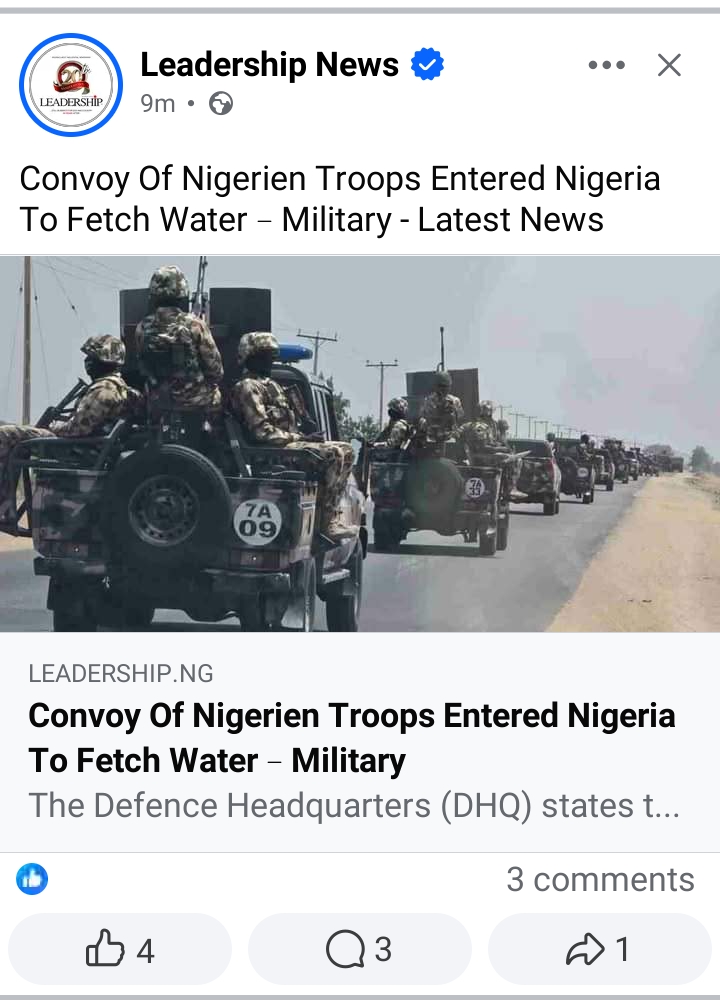

The Defence Headquarters (DHQ) has clarified the circumstances surrounding a Nigerien military convoy’s unexpected entry into Mazanya village in Jibia Local Government Area of Katsina State—a development that initially caused panic among residents and stirred public debate about Nigeria’s border security.
According to DHQ, the Nigerien troops crossed into Nigerian territory on 29 November 2025 at approximately 1500 hours, travelling in a large convoy comprising four gun trucks and one Toyota Jeep. Their stated mission, confirmed by the Director of Defence Media Operations, Major General Michael Onoja, was to fetch water—a task described as a long-standing routine traditionally carried out by soldiers from the Niger Republic in that border region.
The presence of the heavily armed convoy immediately unsettled the community. Local vigilante groups, already on edge due to years of insecurity in border towns, interpreted the movement as a potential hostile incursion. The size of the military vehicles, their formation, and the lack of prior communication heightened suspicion. This misunderstanding escalated quickly, with the vigilantes opening fire on the Nigerien troops under the assumption that an attack was underway.
Related News
Nigeria Moves to Modernise Air Defence Systems Amid Growing Security Concerns
Nigeria is reviewing proposals from Chinese and European defence companies to modernise its ageing air defence infrastructure as part of…
Tinubu Approves Salary Increase for Nigerian Armed Forces Personnel
President Bola Ahmed Tinubu has approved a salary increase and improved allowances for members of the Nigerian Armed Forces as…
Captain Abiodun Abidemi Folorunsho Appointed Director of Naval Information, Nigerian Navy
The Nigerian Navy has appointed Captain Abiodun Abidemi Folorunsho as its new Director of Naval Information and official spokesperson, following…
Major General Onoja stated that the situation could have worsened without rapid intervention. Security authorities from both countries engaged in direct communication, enabling swift de-escalation. After dialogue with the Nigerien commander on ground, the troops were allowed to proceed with their water collection as intended. They later returned across the border without further confrontation or damage reported.
The explanation, however, has generated intense reactions across social media and public forums. Many Nigerians questioned the plausibility of a foreign military entering the country—armed and in full convoy—simply to fetch water. Critics argue that such a practice undermines Nigeria’s territorial integrity and exposes severe gaps in border management. Commenters compared the scenario to military forces from Mexico entering the United States or troops from another sovereign nation casually rolling across international lines for basic necessities.
Concerns were also raised about why Nigerien forces would require such a large armed presence for a routine water-fetching activity, and why Nigerian authorities would allow this historically without establishing formal protocols or communication channels to avoid panic. For residents of Mazanya and neighbouring communities, the incident revived long-standing fears about porous borders, militant movements, and inadequate government protection.
In online discussions, Nigerians expressed disbelief, anger, and frustration. Some users called the explanation an insult to public intelligence; others lamented what they described as years of weakened border control, compromised security leadership, and political mismanagement. A number of participants framed the incident within broader geopolitical tensions involving the Sahel region, insurgency, and strained Nigeria–Niger relations following recent political changes in both countries.
Still, the DHQ maintains that the crossing was neither an invasion nor an act of aggression. It insists that the wheels of military diplomacy resolved the misunderstanding quickly and prevented escalation. The statement reassured the public that Nigeria remains committed to maintaining peaceful relations with its neighbours while addressing insecurities along its borders.
The incident adds to growing scrutiny of Nigeria’s border governance, fuelling debate about whether existing systems adequately protect sovereignty in an environment where cross-border threats—armed groups, banditry, smuggling, and militant networks—continue to evolve. For Mazanya residents, the episode may be over, but the broader questions it raises linger far beyond their village.