Pat Utomi’s 2006 Presidential Aspiration: How the ADC Sought to Challenge PDP Dominance
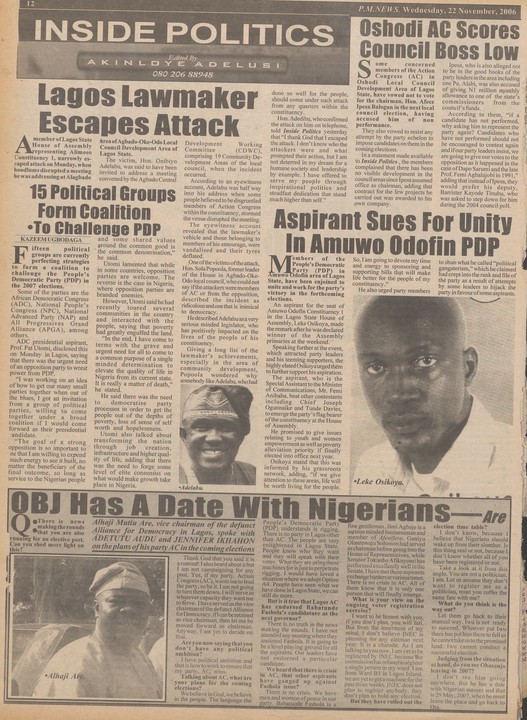

Professor Pat Utomi, a respected economist, academic, and public policy advocate, once sought Nigeria’s highest political office under the platform of the African Democratic Congress (ADC) during the build-up to the 2007 general elections. His aspiration, which dates back to 2006, emerged at a time when opposition politics in Nigeria was largely fragmented and dominated by attempts to counter the overwhelming influence of the ruling Peoples Democratic Party (PDP).
In 2006, reports published by P.M. News revealed that no fewer than 15 political groups and parties were engaged in coalition talks aimed at presenting a credible opposition capable of challenging the PDP’s grip on power. Among the parties involved were the African Democratic Congress (ADC), National People’s Congress (NPC), National Advanced Party (NAP), and the All Progressives Grand Alliance (APGA), alongside several other political movements.
Related News

Henry Seriake Dickson Defects from PDP to Newly Formed Nigeria Democratic Congress
Senator Henry Seriake Dickson has formally defected from the Peoples Democratic Party (PDP) to the newly registered Nigeria Democratic Congress…

Hon. Sarah Ivie Adidi Receives “Her Excellence Award” During International Women’s Day Event in Abuja
Reps aspirant Sarah Ivie Adidi has been honoured with the 2026 “Her Excellence Award” during an event marking International Women’s…
Governor Peter Mbah Urges Ndigbo to Return to Strategic Politics
Peter Mbah, Governor of Enugu State, has urged the Igbo political class to return to what he described as “strategic…
At the time, Professor Utomi was identified as a presidential aspirant on the platform of the ADC. Speaking in Lagos during the coalition discussions, Utomi stressed the urgent need for a strong and united opposition in Nigeria. He argued that democracy thrives on healthy competition and that no political party should be allowed to dominate the system unchecked.
Utomi also used the occasion to lament what he described as the hostile environment faced by opposition parties in Nigeria. According to him, while opposition groups are regarded as essential components of democratic governance in many countries, the situation in Nigeria was markedly different. He observed that opposition parties were often portrayed as enemies of the state rather than legitimate alternatives within a democratic framework.
The political atmosphere of the mid-2000s was characterised by the near-total dominance of the PDP, which controlled the presidency, the National Assembly, and the majority of state governments. Opposition parties struggled with limited access to state resources, internal divisions, and what they perceived as institutional bias. It was against this backdrop that figures like Utomi attempted to promote coalition politics as a means of levelling the playing field.
Although the proposed opposition coalition did not ultimately succeed in unseating the PDP in the 2007 elections, the effort represented one of the early attempts at broad-based opposition cooperation in Nigeria’s Fourth Republic. Analysts note that these early coalition talks laid some groundwork for future opposition alliances, including those that eventually culminated in the formation of the All Progressives Congress (APC) years later.
Professor Utomi’s 2006 aspiration also forms part of a broader pattern of his engagement with Nigerian politics. Over the years, he has been involved in policy advocacy, political movements, and reform-oriented campaigns, often positioning himself as a voice for institutional reform, accountability, and economic restructuring. His repeated involvement in political debates and electoral processes has earned him both supporters and critics, with some describing him as a persistent reform advocate and others questioning the electoral impact of his ambitions.
In retrospect, Utomi’s ADC presidential bid serves as a historical reference point for understanding Nigeria’s evolving opposition politics. It reflects the challenges faced by smaller parties in confronting entrenched political power, as well as the recurring debate over the role of coalition-building in strengthening democracy. Nearly two decades later, the issues raised during that period—opposition marginalisation, party dominance, and democratic inclusion—remain central to Nigeria’s political discourse.