PDP Governors Arrive Ibadan for National Convention Amid Conflicting Court Orders and INEC Boycott Signal


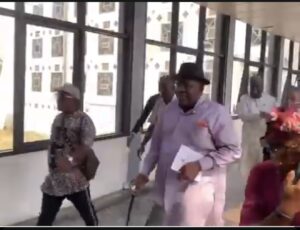
Four governors of the Peoples Democratic Party (PDP) arrived in Ibadan, Oyo State, on Friday as preparations continued for the party’s national convention despite a Federal High Court ruling suspending the exercise. Their arrival comes amid intensifying internal disputes, legal uncertainties, and concerns about the implications of the Independent National Electoral Commission’s (INEC) potential boycott.
The PDP’s South-West chairman, Kamorudeen Ajisafe, confirmed to Saturday PUNCH that the governors of Bauchi (Bala Mohammed), Zamfara (Dauda Lawal), Adamawa (Ahmadu Fintiri), and Oyo (Seyi Makinde) had arrived in the state for the convention. The gathering signals the party’s decision to move forward with the event, even as legal questions about its legitimacy remain unresolved.
The Federal High Court ruling, which ordered the party to suspend the convention, has triggered strong reactions within PDP ranks. The court order adds to months of internal divisions, leadership disputes, and accusations of external interference. In contrast to the Federal High Court directive, an Oyo State High Court reportedly issued a ruling allowing the convention to proceed, creating a conflicting legal environment that has further complicated matters.
Observers note that this multiplicity of court orders has become a recurring feature of Nigeria’s political processes, especially during party leadership transitions. Legal analysts have raised concerns about the need for judicial reforms to prevent overlapping rulings by courts of coordinate jurisdiction. Some commentators argue that the contradictions have weakened public confidence in legal institutions.
Related News
Henry Seriake Dickson Defects from PDP to Newly Formed Nigeria Democratic Congress
Senator Henry Seriake Dickson has formally defected from the Peoples Democratic Party (PDP) to the newly registered Nigeria Democratic Congress…

Hon. Sarah Ivie Adidi Receives “Her Excellence Award” During International Women’s Day Event in Abuja
Reps aspirant Sarah Ivie Adidi has been honoured with the 2026 “Her Excellence Award” during an event marking International Women’s…
Governor Peter Mbah Urges Ndigbo to Return to Strategic Politics
Peter Mbah, Governor of Enugu State, has urged the Igbo political class to return to what he described as “strategic…
The uncertainty increased on Friday after indications emerged that INEC might boycott the convention. Analysts say the absence of the electoral commission from proceedings could lead to questions about the validity of any decisions or leadership changes made at the event. Some party supporters interpreted INEC’s possible non-attendance as a major setback that could deepen the PDP’s ongoing internal crisis.
Reactions from members of the public highlight widespread frustration with the state of the party and Nigeria’s political institutions more broadly. Several commentators described the situation as evidence of weakened party structures and declining adherence to internal processes. Others expressed concern that the PDP, once the dominant political force in Nigeria, has struggled to maintain a unified leadership capable of navigating internal disputes.
Some reactions focused on broader systemic concerns, including the use of court orders by political actors to influence party leadership outcomes. Critics argue that the courts and legislative institutions are increasingly caught in the middle of political power struggles, leading to perceptions that their independence is eroding.
One recurring theme among public responses is the belief that the PDP’s internal conflicts have created openings for rival parties. Some commentators suggested that the situation could strengthen the ruling All Progressives Congress (APC), particularly if leadership disputes prevent the PDP from presenting a united front ahead of future elections. Others argued that the APC itself could face similar issues if it fails to maintain internal cohesion, noting that several political parties in Nigeria have historically struggled to sustain discipline and ideological clarity.
Despite the controversy, PDP leaders in Ibadan appear determined to proceed with the convention. Party insiders say the governors’ presence signals a commitment to move forward with or without INEC’s participation. Some supporters argue that delaying the convention further could worsen internal disagreements, while others insist the party must respect court orders to avoid future legal challenges.
As events continue to unfold, political stakeholders and analysts are watching closely to see whether the PDP can navigate the conflicting legal directives, internal pressures, and institutional scrutiny. The convention’s outcome may have significant implications for the party’s future direction, national relevance, and readiness for upcoming electoral cycles.
The next steps remain unclear, particularly regarding how INEC will interpret the legal situation and whether the courts will issue further rulings. For now, the PDP’s determination to proceed highlights both its urgency to resolve leadership matters and the complex environment in which Nigerian political parties operate.