South-West States Sign Landmark MOU With NRC to Develop Regional Rail Network
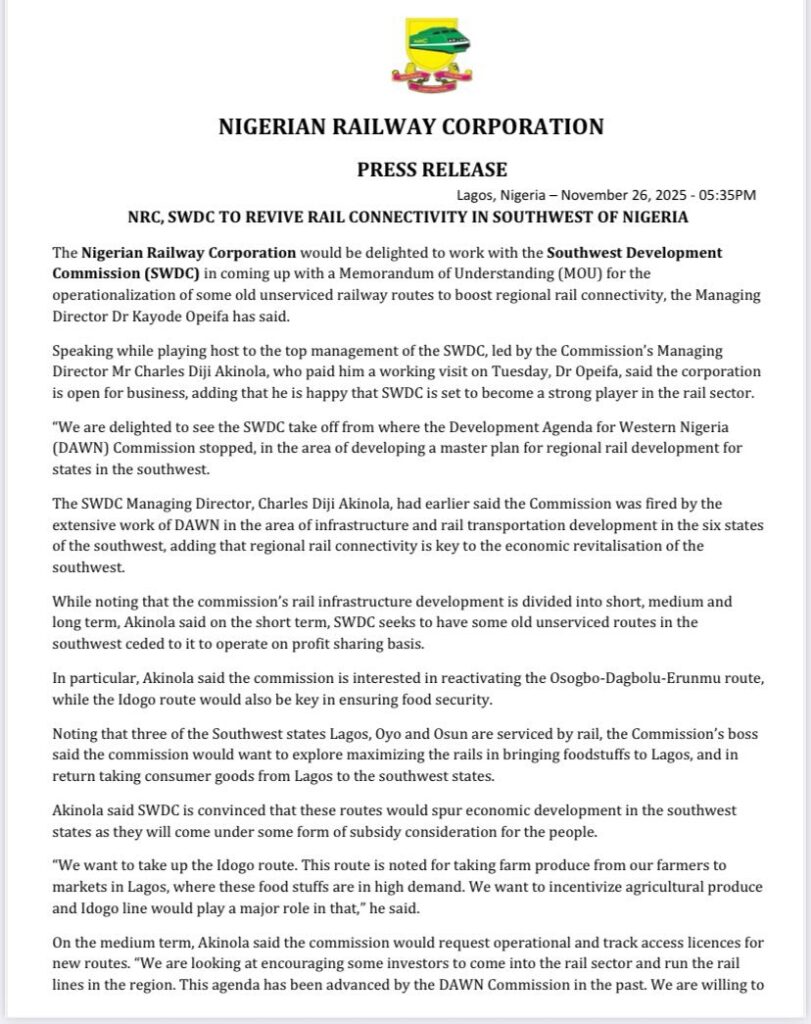

The six states of Nigeria’s South-West region have jointly signed a Memorandum of Understanding (MOU) with the Nigerian Railway Corporation (NRC) to develop an interconnected regional rail network, marking one of the most ambitious transportation initiatives in the geopolitical zone’s recent history. The agreement, facilitated through the South-West Development Commission (SWDC), is designed to create a seamless rail system linking Lagos, Ogun, Oyo, Osun, Ondo, and Ekiti States, with financing expected to come from a combination of SWDC funds and private sector partnerships.
The proposed project seeks to address one of the region’s most persistent challenges: safe, efficient, and integrated transportation for both people and goods. With the South-West serving as Nigeria’s most economically active zone—home to major industrial clusters, ports, and commercial centers—the establishment of a modern rail network is widely seen as a strategic investment capable of transforming mobility, reducing travel time, and stimulating economic growth across multiple sectors.
According to early discussions, the rail system is expected to include both passenger and freight lines, with routes designed to connect key urban centers, industrial estates, agricultural belts, and emerging economic hubs. The initiative aligns with the long-term regional development goals of boosting productivity, reducing road congestion, and enhancing intra-regional trade.
Related News
Aerial Footage Shows Progress on Sokoto–Badagry Super Highway Construction
New aerial footage circulating online has revealed ongoing construction work on the proposed Sokoto–Badagry Super Highway, a major infrastructure project…
Kaduna State Government Takes Over Ahmadu Bello Stadium, Begins Major Reconstruction
The Kaduna State Government has officially taken over ownership of the iconic Ahmadu Bello Stadium from the Federal Government, following…
Umahi Inspects Ongoing Rehabilitation of Lagos–Ota–Abeokuta Expressway
Minister of Works David Umahi has inspected the rehabilitation of the Lagos–Ota–Abeokuta Expressway, describing the project as a priority infrastructure…
Transportation specialists say the partnership model—where SWDC collaborates directly with the NRC while leveraging private capital—could represent a shift toward more sustainable infrastructure financing in Nigeria. Public-private partnerships (PPPs) have increasingly become the preferred approach for large-scale infrastructure projects due to the high cost of construction, maintenance, and long-term operations. By adopting this model, the South-West aims to accelerate project timelines and ensure technical expertise is woven into every stage of development.
The MOU also reflects the growing trend of subnational collaboration in Nigeria. Regional cooperation has become more prominent in recent years as states seek collective solutions to common economic and infrastructural challenges. For the South-West, whose states already collaborate within frameworks such as DAWN Commission, this renewed push for integrated development underscores a commitment to long-term planning beyond political cycles.
Stakeholders believe the regional rail network could yield substantial socioeconomic benefits. Improved connectivity between states could expand labor mobility, boost tourism, and lower the cost of moving goods. Farmers may gain faster access to markets, manufacturers could benefit from more reliable logistics, and urban commuters may finally see relief from chronic gridlock on major highways.
However, analysts also caution that rail projects of this scale require strong governance, transparent financial management, and strict adherence to technical standards. The success of the initiative will depend heavily on sustained collaboration between state governments, federal institutions, private investors, and local communities. Issues such as land acquisition, environmental impact assessments, and long-term operational funding will need to be addressed carefully.
Despite these challenges, the signing of the MOU represents a significant step forward. For many observers, it signals a new era of regional self-direction and infrastructural ambition. If fully implemented, the South-West rail network could become a model for other regions in Nigeria seeking to strengthen economic integration and build modern transport systems capable of supporting future growth.
In the coming months, feasibility studies, route mapping, engineering assessments, and financing negotiations are expected to intensify. While timelines have not yet been publicly confirmed, the momentum created by the agreement has been widely applauded as a promising beginning for a project that could reshape mobility across the South-West for decades to come.