Tinubu Steps In Again as Rivers Political Crisis Deepens Between Wike and Fubara
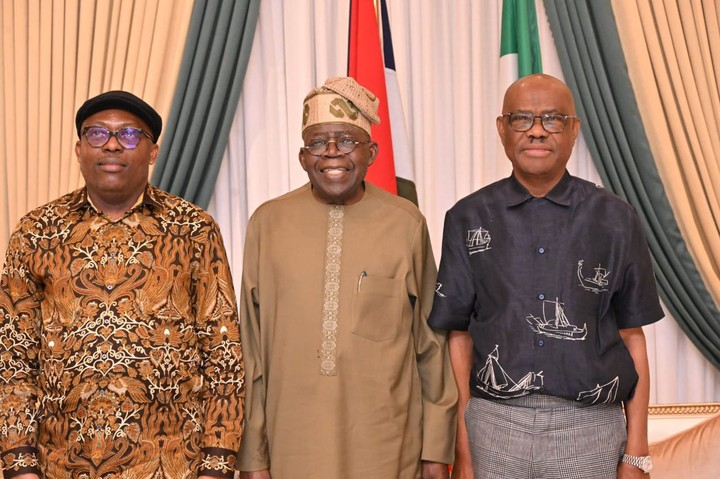

President Bola Tinubu has reportedly re-entered the fray in the prolonged political feud between Rivers State Governor Siminalayi Fubara and the Minister of the Federal Capital Territory, Nyesom Wike, amid growing concerns over stability, party cohesion, and national interest. Credible sources indicate that the President has taken steps to intervene following the resurgence of impeachment threats against the Rivers governor and his deputy.
According to a source close to the presidency, Tinubu has summoned Wike for a meeting over the deepening Rivers crisis, with plans for the engagement to take place outside Nigeria. The source disclosed that the President, who is currently on an overseas trip, intends to personally address the matter, describing recent developments as dangerous and politically destabilising.
Parallel to this, it was gathered that Governor Fubara travelled out of the country on Thursday aboard a private jet, with indications that he intends to meet President Tinubu in France. The simultaneous foreign trips by both political actors have further fueled speculation of behind-the-scenes presidential mediation aimed at preventing a full-blown constitutional and security crisis in Rivers State.
The renewed intervention comes against the backdrop of a fresh impeachment process initiated against Governor Fubara and his deputy, Ngozi Odu, by members of the Rivers State House of Assembly believed to be loyal to Wike. During a plenary session presided over by Speaker Martins Amaewhule, the Majority Leader, Major Jack, formally read out a notice of allegations and gross misconduct against the governor.
The allegations against Fubara include the demolition of the State Assembly complex, alleged extra-budgetary spending, withholding funds meant for the Assembly Service Commission, and failure to comply with a Supreme Court ruling affirming the financial autonomy of the legislature. His deputy was accused of reckless and unconstitutional expenditure of public funds, obstructing the Assembly’s legislative functions, and allegedly facilitating the occupation of government offices by individuals who had not been properly screened by lawmakers.
Related News
Henry Seriake Dickson Defects from PDP to Newly Formed Nigeria Democratic Congress
Senator Henry Seriake Dickson has formally defected from the Peoples Democratic Party (PDP) to the newly registered Nigeria Democratic Congress…

Hon. Sarah Ivie Adidi Receives “Her Excellence Award” During International Women’s Day Event in Abuja
Reps aspirant Sarah Ivie Adidi has been honoured with the 2026 “Her Excellence Award” during an event marking International Women’s…
Governor Peter Mbah Urges Ndigbo to Return to Strategic Politics
Peter Mbah, Governor of Enugu State, has urged the Igbo political class to return to what he described as “strategic…
Speaker Amaewhule announced that the impeachment notice would be served on the governor within seven days, adjourning plenary until January 15. He defended the move as being in the interest of Rivers State, accusing Fubara of deliberately refusing to present the 2026 budget to the Assembly, which he said amounted to an erosion of legislative authority.
Notably, the allegations mirror those raised during the earlier political standoff that led President Tinubu to declare a state of emergency in Rivers State in March 2025, resulting in the temporary suspension of the governor and his deputy for six months. That intervention followed fears of a breakdown of law and order and its potential impact on oil production. A truce brokered by Tinubu at the time briefly restored calm between Wike and Fubara, but the peace proved short-lived.
Barely months after the emergency rule was lifted, both camps resumed open hostilities. Wike accused his successor of reneging on earlier agreements, while Fubara made subtle public criticisms of his former political benefactor. The impeachment move now represents the sharpest escalation in the renewed confrontation, with Wike openly insisting that Fubara would not secure a second term, even if he aligned with the All Progressives Congress (APC).
A senior source warned that the President views the impeachment push as reckless and potentially explosive, particularly given the ethnic and regional sensitivities involved. The official cautioned that removing the first Ijaw governor of Rivers State through impeachment could provoke unrest among Niger Delta youths and disrupt oil production, outcomes Tinubu is reportedly keen to avoid.
While some presidential aides claimed they were unaware of any scheduled meeting between Tinubu and Wike, others noted that the FCT minister would have little reason to travel to the Middle East or Europe without a direct presidential invitation. Meanwhile, APC leaders at the national level are said to be uneasy with Wike’s actions, arguing that they undermine party unity and portray the President as weak.
A senior APC official lamented that the Rivers crisis was becoming an unnecessary distraction at a time Nigeria faces mounting security and economic challenges. The official urged Tinubu to rein in Wike, warning that continued political brinkmanship could damage the President’s standing and the party’s image nationwide.
Adding to the chorus of concern, former senator Andrew Uchendu described the prolonged crisis as an embarrassment to Rivers State, calling for a roundtable dialogue involving all stakeholders and elder statesmen. Former Ekiti State Governor Ayo Fayose, speaking from personal experience, warned that impeachment remains a real threat to Fubara, advising him to adopt humility, reconciliation, and caution.
Despite the tensions, Wike has continued public engagements in Rivers State, urging unity among political leaders and rallying support for Tinubu’s re-election in 2027. He maintained that the state’s politics had evolved into what he termed a “Rainbow Coalition” and insisted that internal disputes would be addressed at a later time.
As events unfold, attention remains fixed on President Tinubu’s next move and whether his intervention will once again succeed in dousing the flames of one of Nigeria’s most volatile political rivalries.