Trump Excludes South Africa From 2026 G20 Summit as Diplomatic Rift Deepens
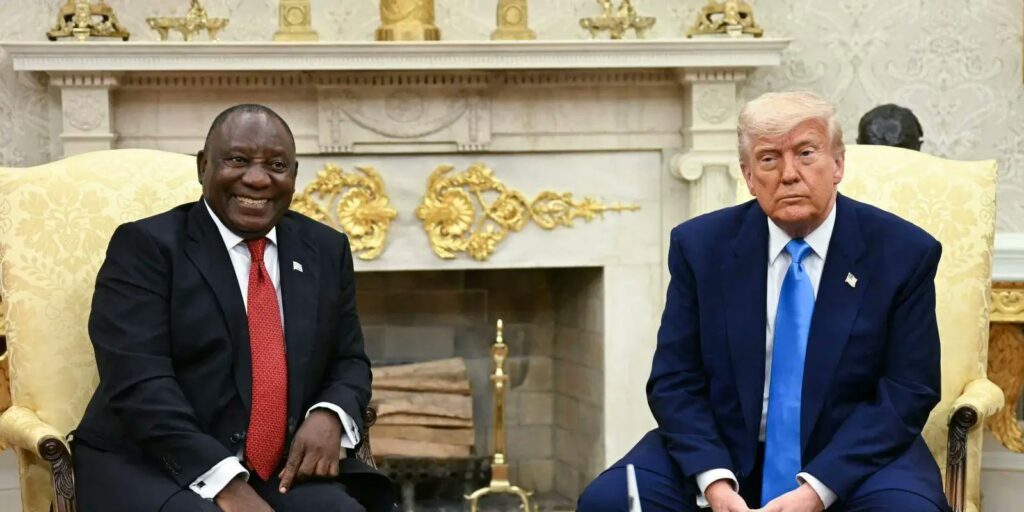

A major diplomatic dispute erupted on November 26, 2025, after former United States President Donald Trump announced that South Africa would not be invited to the 2026 G20 Summit scheduled to take place in Miami, Florida. The declaration, published on Trump’s Truth Social account, triggered strong responses from the South African government and sparked widespread debate across international and online communities.
In his statement, Trump accused the South African government of failing to address what he described as “horrific human rights abuses” allegedly occurring against Afrikaners and other descendants of Dutch, French, and German settlers. He claimed that white farmers were being targeted, their lands seized, and that global media organizations were intentionally ignoring the issue. According to Trump, this alleged failure by South Africa to act responsibly justified the United States’ absence from the recently concluded G20 Summit hosted in Johannesburg.
Trump further asserted that South Africa had refused to formally hand over the G20 presidency to a senior U.S. representative during the closing ceremony. He claimed that, under his direction, the United States would cut all aid, payments, and subsidies to South Africa “effective immediately,” describing the country as “not worthy of membership anywhere.” His post concluded with a declaration that South Africa would not receive an invitation to the upcoming 2026 G20 gathering.
The South African Presidency issued a detailed response rejecting Trump’s claims and expressing deep concern over the statement. According to officials, all G20 members who attended the 2025 Summit praised the event as one of the most successful in recent years. The summit produced a joint declaration reaffirming global multilateral cooperation and the importance of unified action in addressing worldwide challenges.
Related News
Nigeria, Germany Move to Deepen Cooperation on Security, Power and Infrastructure
Nigeria and Germany have reaffirmed plans to strengthen bilateral relations following a high-level telephone conversation between President Bola Tinubu and…
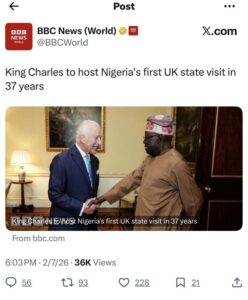
King Charles III to Host Nigerian President Tinubu in First UK State Visit in 37 Years
Buckingham Palace has confirmed that King Charles III will host Nigerian President Bola Ahmed Tinubu and First Lady Oluremi Tinubu…
Macron Says “China Is Welcome” in Europe as Trade Tensions With U.S. Reshape Global Alliances
French President Emmanuel Macron has declared that “China is welcome” in Europe, a statement that has intensified debate about Europe’s…
The Presidency emphasized that because the United States did not attend the summit by its own choice, G20 documentation and instruments were formally handed over to a U.S. Embassy official at South Africa’s Department of International Relations and Cooperation—standard protocol when a country’s head of delegation is absent.
South Africa also reiterated that its G20 membership is not dependent on the United States, but on consensus among all nations within the forum. As a sovereign democratic state, officials stressed that South Africa would not accept insults questioning its worthiness or standing among the global community.
In its statement, the Presidency noted that U.S. businesses, civil society groups, and other institutions participated extensively in G20-related events such as the B20 and G20 Social, further showing that cooperation between both nations continued despite political tensions at the highest level.
South Africa maintained that it would continue to participate in the G20 as a full and active member and called on all nations to uphold the principles of multilateralism, equality, and consensus that define the forum.
The government described Trump’s allegations and punitive stance as being driven by “misinformation and distortions,” particularly disappointing given ongoing efforts to improve diplomatic relations. Despite the dispute, South Africa reaffirmed its commitment to constructive global engagement.
Online reactions to the incident ranged from criticism of Trump’s tone and approach to questions about the legitimacy of excluding another G20 member. Commentators highlighted geopolitical undercurrents—including South Africa’s position within BRICS and its recent actions in international legal forums—as potential factors in the escalating tension.
The situation continues to generate global attention as analysts assess the potential diplomatic, economic, and political consequences of the growing rift.