Trump Says European Leadership Brings “Chaos and Decline,” Pushes U.S. Role in Greenland’s Future
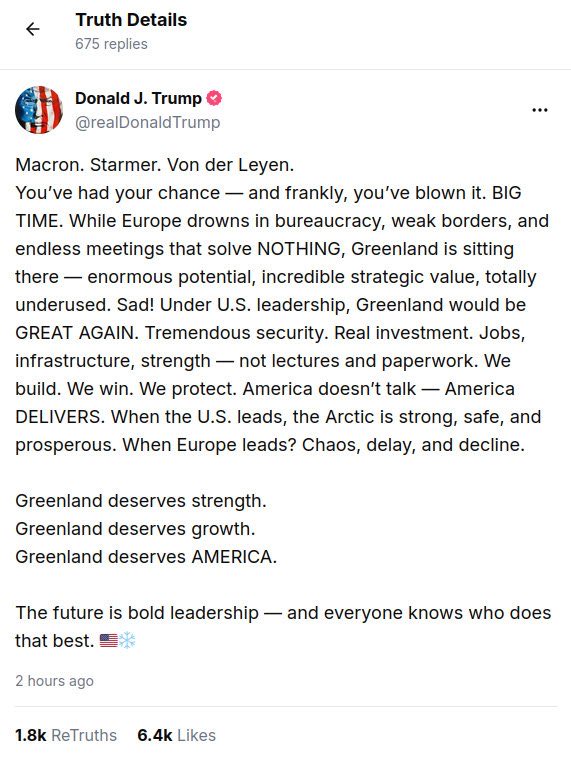

Former United States President Donald Trump has once again placed himself at the center of international debate after issuing a strongly worded statement criticizing European leadership and calling for greater American involvement in Greenland. In a message shared under his name on social media, Trump accused key European leaders of presiding over what he described as years of stagnation, bureaucratic paralysis, and strategic decline.
Referencing French President Emmanuel Macron, UK Prime Minister Keir Starmer, and European Commission President Ursula von der Leyen, Trump argued that Europe had squandered opportunities in the Arctic region. According to him, Greenland — an autonomous territory within the Kingdom of Denmark — represents enormous untapped potential that Europe has failed to develop effectively.
Trump described Greenland as strategically vital and economically underutilized, claiming that under U.S. leadership the territory would experience significant investment, stronger security, and tangible infrastructure development. “While Europe drowns in bureaucracy, weak borders, and endless meetings that solve nothing, Greenland is sitting there with incredible strategic value,” the statement read. He added that America “builds, protects, and delivers,” contrasting this with what he characterized as Europe’s preference for process over results.
Related News

Six US Troops Killed in Iranian Strike on Kuwait Port, Says CENTCOM
The United States Central Command has confirmed that six American service members were killed following an Iranian strike on a…

Trump-Linked Financier Signs Preliminary Gas Deal With Russia’s Novatek for Alaska Project
An American financier with ties to former U.S. President Donald Trump has reportedly signed an early-stage agreement with Russian energy…

US Commends NAF Ahead of AH-1Z Helicopter Delivery
The United States Government has praised the Nigerian Air Force for its preparedness ahead of the delivery of AH-1Z attack…
The former president went further by asserting that American leadership is essential for Arctic stability. In his view, when the United States leads, the region becomes “strong, safe, and prosperous,” while European leadership produces “chaos, delay, and decline.” He concluded by stating that Greenland “deserves strength, growth, and America,” framing U.S. involvement as both inevitable and beneficial.
Trump’s comments immediately generated intense reactions across online platforms. Supporters applauded the message as a rare example of decisive leadership, arguing that Europe has struggled with internal divisions, slow decision-making, and inconsistent security policies. Some commentators claimed that Trump’s blunt rhetoric merely stated what others were unwilling to say publicly about Europe’s geopolitical weakness.
Critics, however, questioned both the tone and substance of the statement. Several users argued that Greenland’s current governance under Denmark has delivered relatively high standards of living, political representation, and social stability when compared to some U.S. territories. Others warned that Trump’s language risked undermining international law, diplomatic norms, and existing alliances, particularly within NATO.
There were also disputes over the authenticity of the statement, with some commentators urging readers to verify Trump’s official social media channels before accepting the post as genuine. This skepticism reflects a broader trend of heightened sensitivity to misinformation surrounding high-profile political figures.
Beyond Greenland, the discussion quickly expanded into wider debates about Europe’s global role, U.S. foreign policy, and the balance of power in a changing world order. While some participants described European leadership as indecisive and overly cautious, others rejected Trump’s framing entirely, arguing that American leadership has also produced instability in various regions.
Despite the controversy, the remarks underscore Trump’s enduring influence on global political conversations. His willingness to openly challenge allies and reframe long-standing diplomatic arrangements continues to resonate with supporters and alarm critics alike. As geopolitical competition in the Arctic intensifies due to climate change, resource access, and security concerns, Greenland is likely to remain a focal point — regardless of whether Trump’s vision ever translates into policy.