U.S. Congress Highlights Concerns Over Nigeria’s Judiciary, Citing Nnamdi Kanu Case
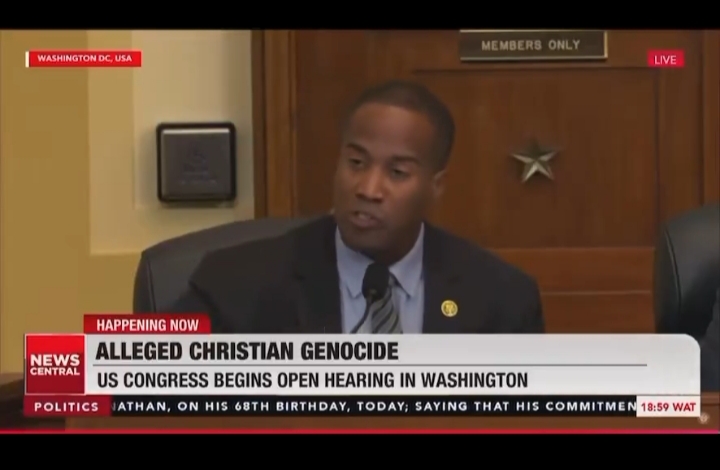

A session of the United States Congress has drawn significant attention after lawmakers openly criticized the state of Nigeria’s judiciary, referencing the prolonged detention and recent conviction of Indigenous People of Biafra (IPOB) leader, Nnamdi Kanu. The discussion, which featured strongly-worded remarks, cited the handling of Kanu’s case as emblematic of broader concerns about the rule of law, political repression, and religious persecution in Nigeria.
During the congressional address, lawmakers played video clips and presented documentation outlining what they described as clear violations of court orders by Nigerian authorities. Central to the remarks was the fact that Nigeria’s Court of Appeal struck out all charges against Kanu in 2022 and ordered his release, yet he remains in solitary confinement. The United Nations Working Group on Arbitrary Detention also previously recommended his unconditional release, a decision that U.S. lawmakers emphasized is still being ignored.
One lawmaker stated, “Mazi Nnamdi Kanu is a clear example. In 2022, Nigeria’s Court of Appeal struck down the charges against Nnamdi Kanu and ordered his release. The UN Group on Arbitrary Detention has also called for his unconditional release. Yet he remains in solitary confinement, in deteriorating health, and recently had to represent himself in court.” The speaker went on to accuse Nigerian authorities of signaling that “the law is optional.”
Related News
UK Prime Minister Keir Starmer Defends Decision Not to Join US-Israel Strikes on Iran
UK Prime Minister Keir Starmer has defended his government’s decision not to participate in initial US-Israel strikes on Iran, insisting…

FIFA and UEFA Presidents Named in ICC Complaint Alleging Complicity in Settlement Activities
Presidents Gianni Infantino and Aleksander Ceferin have been accused of aiding war crimes in a complaint submitted to the International…
Trump Accuses South Africa of Human Rights Abuses and Announces Exclusion from 2026 G20 Summit
U.S. President Donald Trump has accused South Africa of committing severe human rights abuses against white citizens, announcing that the…
The congressional remarks extended beyond Kanu’s case, touching on broader issues of insecurity across Nigeria, particularly attacks on Christian communities in several regions. The speaker described a pattern of violence and alleged government inaction, suggesting that Nigeria’s failure to protect vulnerable populations has contributed to instability. “Nigeria is a nation of tremendous potential, but that potential is being choked out by violent persecution of its Christian population,” the lawmaker said. “No country can build a stable future where churches are burned, believers are killed, and communities live in fear.”
Another part of the discussion focused on U.S. funding. For fiscal year 2025, nearly $8 billion has been requested for Sub-Saharan Africa. However, U.S. lawmakers warned that the American public is increasingly questioning why taxpayer funds should support governments seen to be violating human rights or defying their own courts. The congressman asked, “When Americans see political prisoners, judicial defiance, and the slaughter of Christians, they understandably ask: why should their tax dollars support governments that refuse to protect their own people? Is our aid aiding genocide?”
The comments have sparked widespread reactions across Nigerian online platforms. Some users dismissed the congressional hearing as misinformation or political interference, while others argued that the U.S. is drawing attention to grievances that Nigerian citizens have voiced for years. Several commenters pointed to previous court rulings, the circumstances of Kanu’s arrest in Kenya, and allegations of extraordinary rendition as evidence that the case has been mishandled from the outset.
Others expressed concern that the U.S. criticism could further strain Nigeria’s international relationships. The suggestion that Nigeria is persecuting religious groups, particularly Christians, has also fueled debates about whether the narrative accurately reflects the complexities of Nigeria’s security challenges.
Meanwhile, supporters of Kanu welcomed the congressional remarks, describing them as overdue international recognition of violations surrounding his detention and trial. Opponents, however, maintained that Kanu’s actions threaten national security and characterized the U.S. statements as misleading or incomplete.
Although the U.S. Congress has no direct authority over Nigeria’s judicial processes, its statements carry diplomatic weight. Analysts note that repeated international scrutiny—combined with concerns about aid allocation—may influence future engagements between Washington and Abuja.
The session underscored the growing global attention on Nigeria’s legal and human rights environment, with Nnamdi Kanu’s case emerging once again as a focal point in debates about governance, fairness, and the integrity of state institutions.