US and Nigeria Move to Establish Joint Task Force on Christian Persecution Allegations
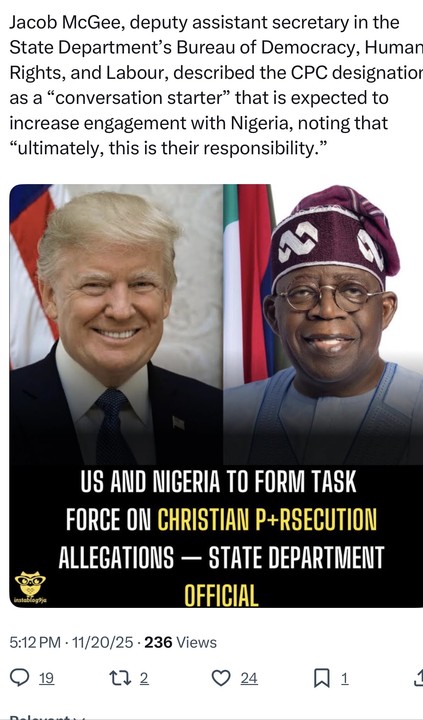

The United States government has announced a collaborative effort with Nigeria to establish a joint task force dedicated to examining and addressing allegations of Christian persecution across the country. The decision, disclosed during a congressional hearing in Washington, marks a renewed engagement between the two countries after the US reclassified Nigeria as a “country of particular concern” (CPC) on grounds of religious freedom violations.
Jonathan Pratt, a senior figure within the US State Department’s Bureau of African Affairs, delivered the announcement while testifying before American lawmakers. According to Pratt, the directive came directly from US Secretary of State Marco Rubio, who instructed the State Department to begin formal coordination with the Nigerian government. Pratt noted that the directive includes developing an action plan and forming a joint task force capable of tackling the issue through multi-dimensional strategies.
The development follows the arrival of a high-level Nigerian delegation in Washington earlier in the week. The delegation, led by National Security Adviser Nuhu Ribadu, also includes the Attorney-General of the Federation and Minister of Justice, Lateef Fagbemi. Their visit was organised to address religious freedom concerns and discuss Nigeria’s designation as a CPC under the Trump administration.
Related News
Nigeria, Germany Move to Deepen Cooperation on Security, Power and Infrastructure
Nigeria and Germany have reaffirmed plans to strengthen bilateral relations following a high-level telephone conversation between President Bola Tinubu and…

King Charles III to Host Nigerian President Tinubu in First UK State Visit in 37 Years
Buckingham Palace has confirmed that King Charles III will host Nigerian President Bola Ahmed Tinubu and First Lady Oluremi Tinubu…

Macron Says “China Is Welcome” in Europe as Trade Tensions With U.S. Reshape Global Alliances
French President Emmanuel Macron has declared that “China is welcome” in Europe, a statement that has intensified debate about Europe’s…
During his remarks, Pratt explained that the proposed task force would not merely be symbolic but would function as an operational framework combining diplomatic, security, policing, and economic tools. He emphasised the need for a comprehensive approach that addresses the complex conditions under which different religious communities experience violence or discrimination.
“The secretary of state has directed us… to work with the Nigerian government on an action plan and to set up a task force to address this issue and use all of the tools at our disposal,” Pratt said. He added that the engagement seeks to “focus minds and focus attention” on the rising concerns surrounding religiously motivated violence.
Pratt further clarified that while the US intends to provide significant support, Nigeria maintains primary responsibility for addressing internal security challenges and protecting its diverse religious communities. He pointed out that the joint approach is meant to strengthen Nigeria’s institutional response rather than supplant it.
Also speaking at the hearing, Jacob McGee, deputy assistant secretary in the Bureau of Democracy, Human Rights, and Labour, described the CPC designation as a catalyst for deeper diplomatic engagement. He characterised the listing not as a punitive measure but as a “conversation starter” intended to open broader dialogue and corrective action.
The news has sparked varied reactions among Nigerian observers. Some commenters welcomed the collaboration as long overdue, citing numerous attacks on religious sites and worshippers across different states. They argue that a joint task force could help pressure Nigerian authorities to act more decisively against armed groups and extremist networks.
Others, however, expressed scepticism about the effectiveness of the initiative, pointing to longstanding concerns about corruption, sabotage, and political interference in security matters. Critics suggested that any partnership involving Nigerian government agencies risks being undermined by internal inefficiencies or selective enforcement.
Despite the divided public reactions, the announcement signals a significant diplomatic shift. With both nations now formally engaged on the matter, the coming months are expected to reveal whether the joint task force can translate policy commitments into tangible outcomes for communities affected by religiously motivated violence.