Trump Accuses South Africa of Human Rights Abuses and Announces Exclusion from 2026 G20 Summit
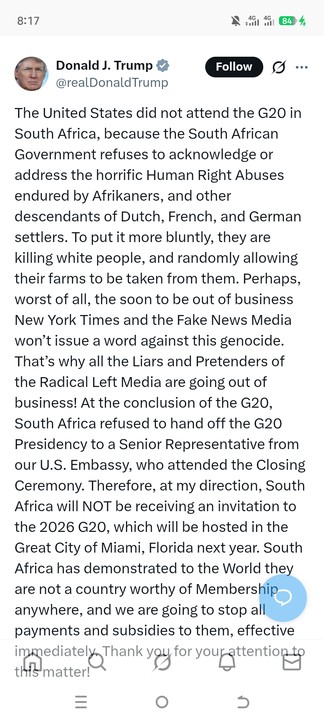

United States President Donald Trump has once again ignited controversy after issuing a public statement accusing the South African government of committing severe human rights violations against white citizens, particularly those of Afrikaner descent. The remarks, shared through his official social media account, alleged that South Africa has failed to address what he described as “horrific human rights abuses” involving violence against white farmers, property seizures, and general insecurity affecting descendants of Dutch, French, and German settlers.
In his statement, Trump declared that the United States did not attend the recently concluded G20 Summit in South Africa because, according to him, the South African government has refused to acknowledge or take action against these alleged abuses. He framed the situation in stark terms, claiming that white citizens in South Africa “are being killed” and that their lands are being taken from them without due process. Trump further criticised American media organisations for what he called a failure to report on the issue, describing them as partisan, unreliable, and unwilling to challenge narratives that conflict with their perceived political interests.
Related News
UK Prime Minister Keir Starmer Defends Decision Not to Join US-Israel Strikes on Iran
UK Prime Minister Keir Starmer has defended his government’s decision not to participate in initial US-Israel strikes on Iran, insisting…

FIFA and UEFA Presidents Named in ICC Complaint Alleging Complicity in Settlement Activities
Presidents Gianni Infantino and Aleksander Ceferin have been accused of aiding war crimes in a complaint submitted to the International…
Jonathan Says Guinea-Bissau Incident Was “Not a Coup”, Describes It as a “Ceremonial Takeover”
Former President Goodluck Jonathan has described the Guinea-Bissau military takeover as “not a coup,” calling it a “ceremonial” incident and…
At the close of the G20 Summit, Trump stated that South Africa declined to transfer the ceremonial presidency of the group to a senior representative from the U.S. Embassy, who was present at the closing ceremony. He described this as an unacceptable diplomatic gesture and announced that, under his direction, South Africa would not receive an invitation to the 2026 G20 Summit scheduled to be held in Miami, Florida. According to Trump, the exclusion would be accompanied by an immediate halt to payments, financial support, and subsidies directed from the United States to South Africa. He concluded his statement by claiming that South Africa had shown itself unworthy of membership or recognition in major international platforms.
Trump’s remarks triggered wide-ranging reactions across online platforms, especially on African discussion forums where users expressed sharply divided opinions. Some commenters dismissed Trump’s claims as inflammatory and unfounded, arguing that no credible evidence supports the allegation of genocide or systematic killings of white South Africans. These users criticised Trump’s rhetoric as overly dramatic and politically motivated. Others pointed out that international media outlets would have widely covered any such developments if they were occurring at the scale he suggested.
Several users attacked Trump’s character directly, describing him as reckless, divisive, or mentally unfit. Some accused him of having ulterior motives tied to geopolitical tensions, particularly referencing recent disputes involving U.S. foreign policy toward African countries that criticised U.S. or Israeli actions at global forums. According to these commenters, Trump’s statement may be a form of retaliation against African leaders who opposed American positions at the United Nations General Assembly.
On the other hand, a smaller number of commenters defended Trump, insisting that incidents of farm attacks and violent crime against white farmers in South Africa are real and have long been ignored. They argued that Trump was drawing attention to an issue that global institutions have allegedly downplayed for political reasons. Some users referenced cases of xenophobia and internal ethnic violence in South Africa as evidence of societal tensions that are often overlooked or selectively interpreted.
The controversy also revived broader debates about racial dynamics, historical land ownership, and crime in South Africa. Experts have consistently noted that South Africa faces high crime rates affecting all communities, and international monitors have repeatedly stated that there is no evidence of a state-sponsored campaign targeting white citizens. Nonetheless, violent incidents on farms, whether affecting white or black residents, continue to be a sensitive and politically charged topic within the country.
As reactions continue to mount, neither the South African government nor official U.S. diplomatic channels have yet issued detailed responses to the latest claims. The debate surrounding Trump’s remarks underscores the complex intersection of race, politics, and international diplomacy in discussions involving South Africa’s internal challenges.